Government agencies operate under constant scrutiny. Audits are a fundamental mechanism for ensuring accountability, protecting public resources, and validating that systems safeguarding sensitive data are functioning as intended. And yet, security audit failures remain stubbornly common — even among agencies that have invested heavily in policies, controls, and compliance frameworks.
These failures are rarely the result of negligence or missing safeguards. More often, they stem from a deeper problem: agencies can no longer prove, consistently and defensibly, that controls are operating as designed. As federal environments grow more complex – spanning hybrid IT, cloud services, operational technology (OT), and remote users – the traditional compliance model simply cannot keep up.
What a Security Audit Is Really Testing
At its core, a government audit is a test of accountability. Auditors trace a clear chain of proof: policy → operations → controls → evidence. The question they must answer is straightforward but unforgiving: Can the agency demonstrate that it did what it said it would do, and can it prove that claim with verifiable evidence?
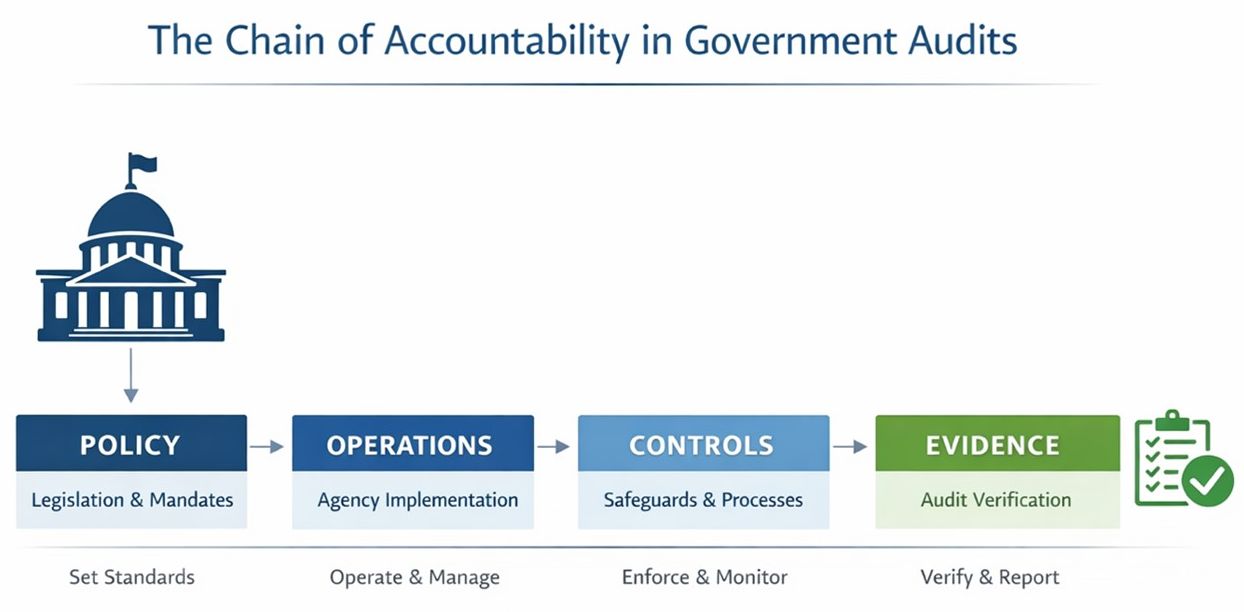
Importantly, audits are not exercises in intent or effort. Auditors do not evaluate how much work went into designing a policy or documenting a control. They evaluate proof. If an agency claims it maintains an accurate asset inventory, access restrictions, or continuous risk monitoring, auditors expect evidence that those claims are true — right now, and over time. When that evidence cannot be produced, the audit fails, regardless of good intentions.
Why ‘Designed Controls’ Still Fail
One of the most common audit pitfalls is confusion between control design and control operation. A control may be well-documented, mapped to NIST or FISMA requirements, and perfectly logical on paper. But auditors test more than theoretical effectiveness.
They ask two distinct questions:
- Would this control mitigate risk if implemented correctly?
- Is the control actually functioning, continuously and consistently, across the environment?
Logs, access histories, configuration states, and monitoring data form the evidence trail auditors evaluate. A control that works only during an audit window—or only in parts of the environment—does not pass. In modern audits, an inability to prove operation is treated no differently than the absence of a control altogether.
Go deeper: Watch our on-demand webinar “The Visibility Gap: The Hidden Reason Government Audits Break Down”.
The Collapse of Manual Evidence
For decades, compliance relied on manual artifacts: screenshots, spreadsheets, written attestations, and after-the-fact reports. While once tolerated, these forms of evidence no longer meet modern audit expectations.
Manual evidence has fundamental limitations. It reflects past states rather than current conditions. It depends on human interpretation, which introduces inconsistency. And it fragments proof across disconnected systems and documents. Most critically, it does not scale. In Zero Trust environments—where identity, device posture, and access must be continuously verified—manual evidence becomes obsolete almost as soon as it is collected.
Frameworks Aren’t the Problem, Evidence Is
Federal oversight frameworks are not broken. Guidance from the GAO Green Book, OMB A‑123 and M‑23‑02, FISMA, and NIST’s Risk Management Framework clearly articulate expectations for internal control, risk management, and accountability. The challenge lies in demonstrating compliance at scale.
As environments grow more interconnected and dynamic, oversight expectations increasingly align with continuous monitoring and real‑time verification. When evidence must be assembled manually across siloed systems, it quickly becomes outdated, incomplete, and difficult to reconcile. Audit findings surface not because the frameworks are flawed, but because the systems responsible for producing evidence cannot keep pace with operational reality.
Complexity Makes the Problem Worse
Large government agencies function as complex ecosystems. Thousands of systems support hundreds of programs, often managed by distributed teams using different tools and data models. Asset inventories become inconsistent. Data lineage is unclear. Financial, IT, and security systems fail to reconcile.
In this environment, proof of compliance must be manually stitched together for every audit. Without a single, operational source of truth, controls cannot be demonstrated across the enterprise. As complexity outpaces visibility, gaps emerge—and auditors inevitably find them.
From “Do You Have a Control?” to “Prove It’s Working Now”
Audit expectations are undergoing a fundamental shift. The historic question, “Do you have a control?” is being replaced by a more demanding test: “Can you prove it is working right now?”
Annual snapshots and point‑in‑time assessments are giving way to continuous assurance models. Auditors increasingly expect live, system‑generated proof produced directly from enforcement systems, with evidence that demonstrates persistence and repeatability over time. In this model, compliance is no longer something you document. It is something you demonstrate operationally.
When Enforcement Becomes Evidence
This is where Unified Zero Trust Network Access (UZTNA) fundamentally changes the compliance equation. In a Zero Trust model, every access request is evaluated based on identity, device posture, and context. Crucially, every enforcement decision is logged, timestamped, and retained.
Controls no longer just restrict access, they automatically generate evidence that they operated. Network access becomes a continuous control surface, a source of live telemetry, and an auditable record of enforcement. Because evidence is produced as a byproduct of normal operations, it remains current, consistent, and defensible.
From Audit Readiness to Operational Confidence
Agencies that break the cycle of repeated audit failures do not focus on producing better documentation. They modernize their operational architecture. By integrating systems, automating controls, and generating evidence directly from enforcement points, compliance becomes embedded in how the organization runs.
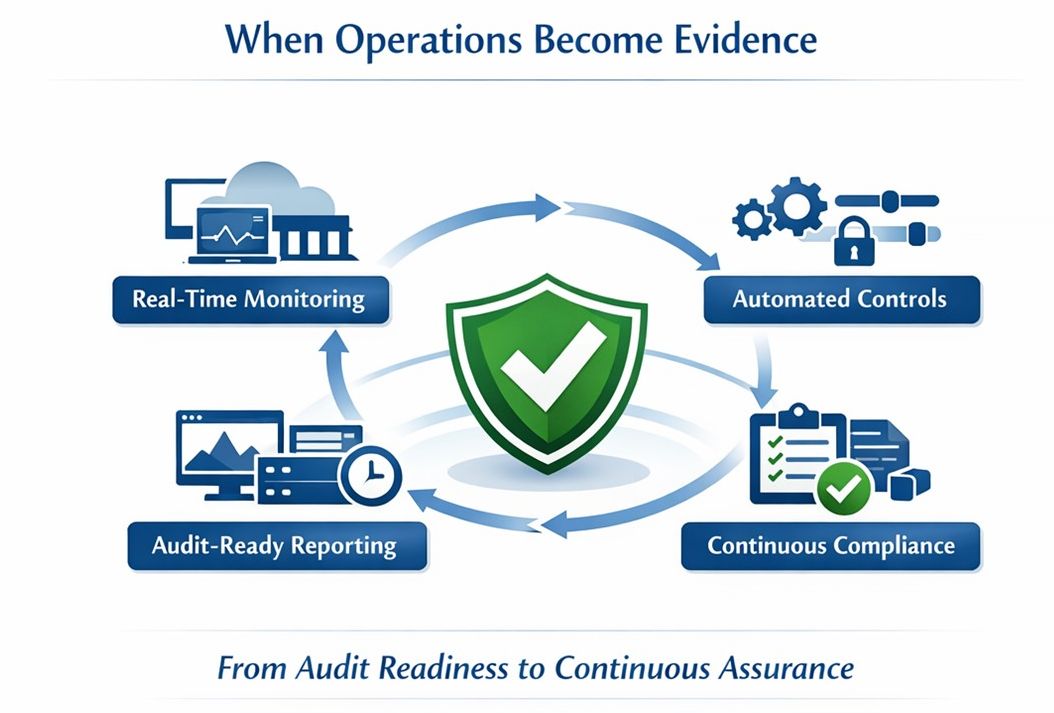
The benefits extend beyond improved audit outcomes. Agencies gain clearer visibility into risk, respond faster to emerging issues, and operate with confidence that controls meet regulatory mandates at all times, not just during audit season. This is the shift from audit readiness to continuous assurance, and it is rapidly becoming the standard for modern government oversight.