Forescout Research –
Vedere Labs
“Vedere” is the Italian word meaning “to see,” which epitomizes the mission of Forescout Vedere Labs, the cybersecurity research arm of Forescout. Our team of global experts focuses on increasing visibility of cybersecurity threats and vulnerabilities for all connected asset types and providing mitigation steps organizations can use to protect themselves.
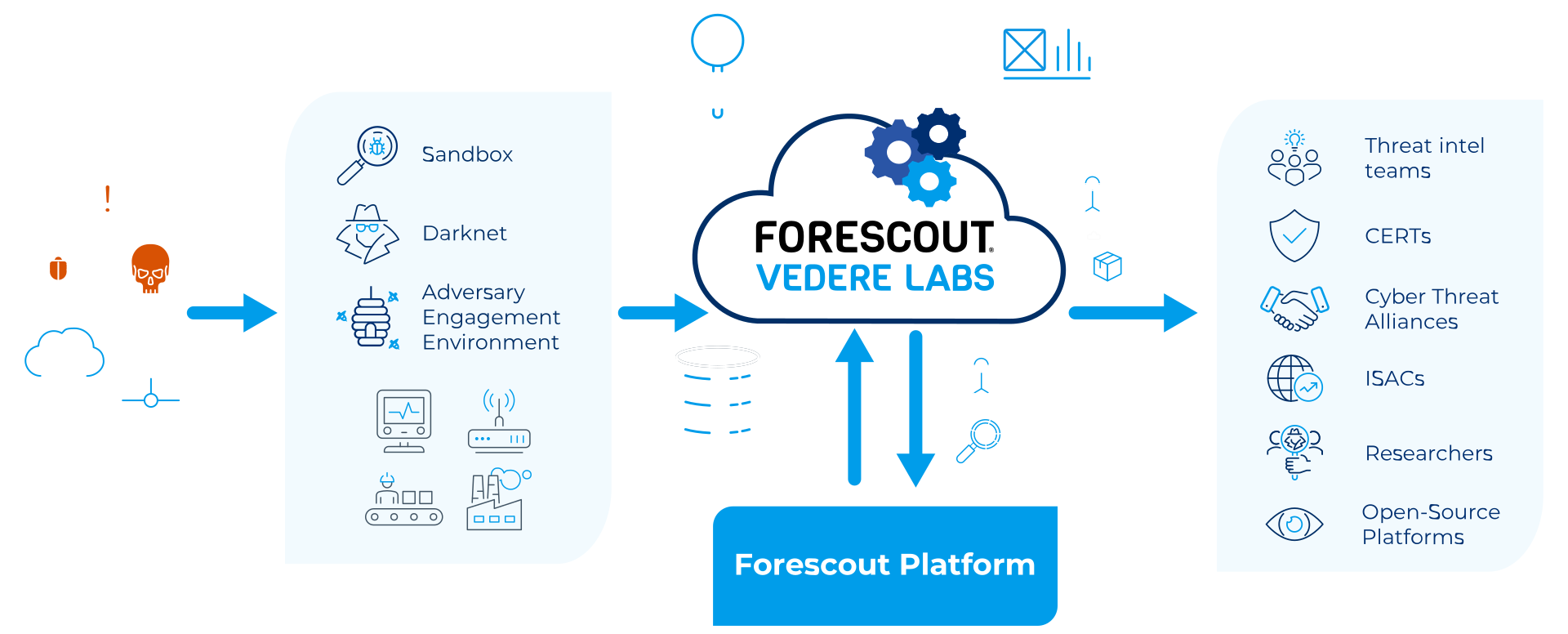
Our research is fed into the Forescout Platform and shared with the cybersecurity community, including CISA and other cybersecurity agencies, CERTs, ISACs, open-source projects, device manufacturers, universities and other researchers.
What We Do

Vulnerability Research
- Focus on vulnerabilities against managed and unmanaged devices (IT/IoT/IoMT/OT)
- 200+ vulnerabilities discovered in last 5 years
- 100+ known exploited vulnerabilities on unmanaged devices

Threat Reports
- Manual and automatic analysis of malware samples collected via customer telemetry and other sources

Threat Intelligence & Detection
- Daily context-rich, machine-consumable threat feeds
- Detection rules to keep our Threat Detection & Response solution on top of emerging threats
- Live dashboards
How We Do It
Forescout Vedere Labs studies what attackers are working towards by observing actual attacks in our sandboxes, on the Darknet and in our Adversary Engagement Environment. We analyze significant attacks and generate vulnerability and threat intelligence that is consumed by the Forescout Platform. We also create corresponding detection rules that are added to Forescout Threat Detection & Response to help ensure customers can protect their IT, OT, IoT and IoMT environments.
Firsthand Observations in Our Research Laboratory
Located in Eindhoven, Netherlands, our research laboratory is where we observe firsthand the vulnerabilities being exploited and attacks in progress. The information we collect is analyzed to generate threat intelligence, calculate multifactor risk scores and create detection rules.
How Vedere Labs Uses Artificial Intelligence
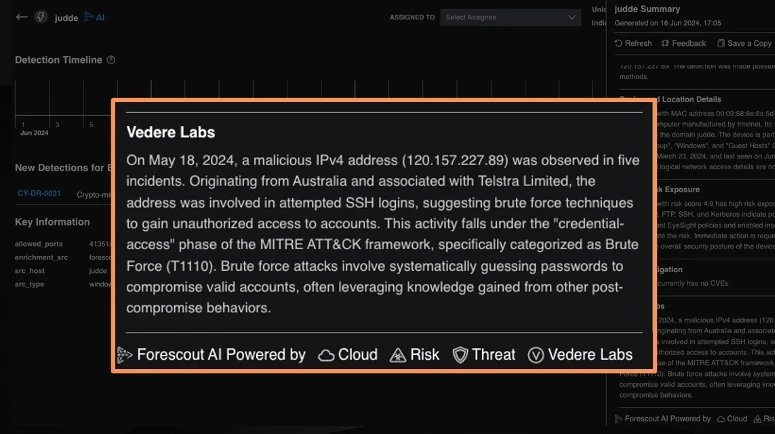
VL threat intelligence is integrated on generative AI products, such as Microsoft Copilot for Security, allowing security analysts to query OT and IoT-specific threat intelligence directly from Forescout Research.
We also have integrated generative AI within our TDR solution, which summarizes proprietary intelligence that can be gathered about IP addresses and other indicators of compromises observed during an incident.
VL KEV: Our Proprietary List of Vulnerabilities
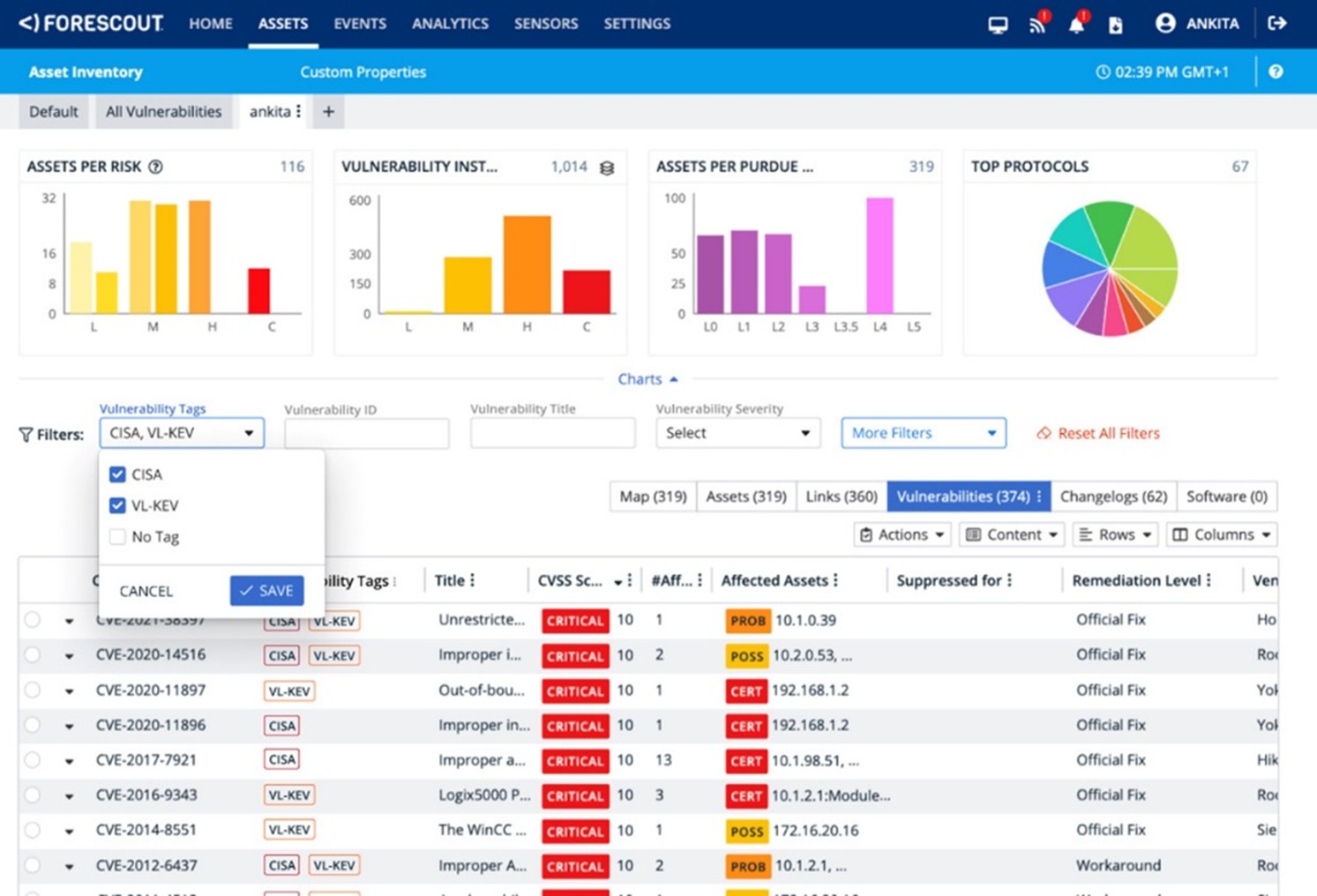
Our KEV list is compiled from real attacks we observe within our OT and IoT-specific honeypots, customer data and third-party intelligence. The list is complementary to industry-standard sources, such as CISA KEV. It is updated in tandem with other threat intelligence for Forescout eyeInspect and REM solutions. This type of intelligence allows users to prioritize vulnerability management actions based on what is currently being exploited by threat actors.
Partnerships and Threat Intelligence Sharing Groups
Vedere Labs is a proud member and contributor to threat intelligence sharing groups, including CERTs, cyber threat alliances and ISACs — where new intelligence and best practices are shared. Member organizations include industry, academia and governments where we share machine-readable intelligence and human-readable reports.
European Energy ISAC
Forescout is a founding member and actively participates in the threat intelligence task force.
ETHOS
Forescout is a founding member and part of the board of directors in this industry partnership dedicated to OT-centric, open-source sharing of anonymous early-warning threat information.
OT-ISAC
Forescout is a partner that shares reports, answers questions about emerging threats and presents at conferences and threat briefing meetings.
CISA JCDC and AIS
Forescout shares indicators of compromise and reports distributed to other members of the JCDC and IAS initiatives.
ACSC CTIS
Forescout shares indicators of compromise and reports distributed to other members of the CTIS initiative.
Data. Lots of Data.
The threat intelligence data we analyze comes from millions of connected devices that we monitor that give us billions of data points about device configuration and network behavior. It also comes from attacks we observe and dissect and other sources that we monitor.

Devices
- 19 million monitored devices
- 39 billion unique data points
- 1,500 global sites
- 6,500+ unique vendors
- 2,300+ unique OS versions

Threats
- 750+ threat actors
- 100+ ransomware group leak sites
- 20+ C2 types monitored on the Internet
- Third-party intel
Forescout Research - Vedere Labs Featured In...

Researchers uncover software flaws leaving medical devices vulnerable to hackers
Researchers say they have found more than a dozen vulnerabilities in software used in medical devices and machinery used in other industries that, if exploited by a hacker, could cause critical equipment such as patient monitors to crash…
Read More
Critical Bugs Expose Hundreds of Thousands of Medical Devices and ATMs
“You can imagine the type of impact an attacker could have when they can either exfiltrate data from medical equipment or other sensitive devices, potentially tamper with lab results, make critical devices unavailable, or take them over entirely…”
Read More
Government cyber workers increasingly concerned hackers will strike during shutdown
The government’s cybersecurity professionals are increasingly concerned that hackers will take advantage of the partial shutdown to tamper with sensitive government data or steal citizens’ information — and that the bare-bones staff won’t be able to fend them off…
Learn More
OT:ICEFALL FINALE
Forescout Vedere Labs is wrapping up its yearlong project looking at design vulnerabilities in operational technology with a closing report today that blames many of the issues they’ve encountered on vendors of the technology not implementing designs that would build security into the systems…
Read More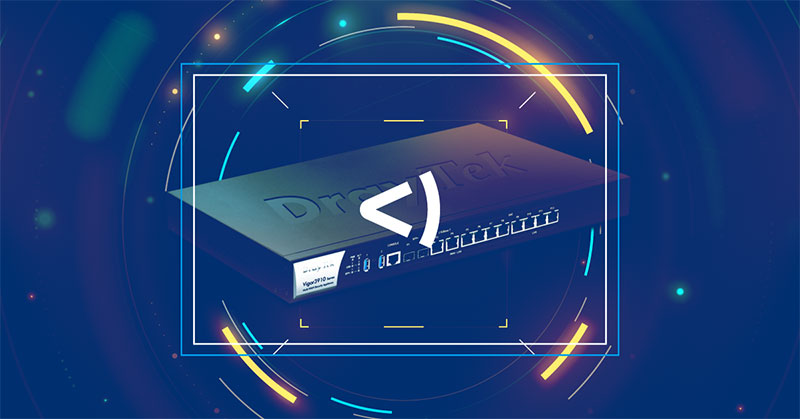
Dray:Break
In 2024, routers are a primary target for cybercriminals and state-sponsored attackers – and are the riskiest device category on networks. We investigated one hardware vendor, DrayTek, with a history of security flaws to help it address its issues and prevent new attacks — especially when ransomware and denial of service attacks are so high today.
Forescout Research. In Your Inbox. Every Month
With 13 cyber attacks every second, it’s hard to keep up.
To help, Vedere Labs now has its own newsletter. Curated by our research leaders, you’ll receive the most crucial information you need to stay ahead of attackers.
It’s loaded with useful context, links and spotlights on threat actors, newly exploited vulnerabilities and other must-know asset intelligence. Once a month. Nice and easy.
Meet Our Leader
Daniel dos Santos
Daniel dos Santos is the Head of Research at Forescout Vedere Labs, where he leads a team of researchers that identifies new vulnerabilities and monitors active threats. He holds a PhD in computer science, has published over 35 peer-reviewed papers, has found or disclosed hundreds of CVEs — and is a frequent speaker at security conferences.

Explore Vedere Labs Blogs
-

PrintNightmare
The Infamous Windows Print Spooler Service Hit Again During June’s 2021 Patch Tuesday, Microsoft addressed a minor local privilege escalation (LPE) vulnerability (CVE-2021-1675) in the Windows Print Spooler service (spoolsv.exe), which is responsible for printing management in Windows. Almost two weeks later, the vulnerability impact was changed from LPE to Remote Code Execution (RCE) after […]
Read More -

Our Commitment to Investing in Channel Partners in 2021
The Enterprise of Things has reached a critical mass and companies everywhere across every industry from healthcare to financial services and manufacturing are struggling to defend their networks against unagentable and unmanaged devices, including IoT and OT. Forescout solves this problem today and helps customers secure the hundreds or thousands of devices connecting across their […]
Read More -

When A Critical Vulnerability Meets A Critical Asset
The analysis behind VMware vCenter Server RCE vulnerability On June 4, 2021, the Cybersecurity & Infrastructure Security Agency (CISA) released an alert, asking VMware customers to urgently patch their systems due to the likelihood of cyber threat actors attempting to exploit the company’s vCenter Server and Cloud Foundation products. The related vulnerabilities were assigned respectively […]
Read More -

Addressing TSA’s Security Directive for Pipeline Owners/Operators
Update: On July 19, the Transportation Security Administration (TSA) released their second security directive for pipelines (SD-2021-02), contents of which were made public by the Washington Post on October 3. While the first security directive focused on establishing key roles (e.g. cybersecurity coordinator), definitions, and responsibilities, the second security directive requires adherence to security controls […]
Read More -

Five steps to protect your enterprise as employees return to the office
The COVID-19 pandemic forced a hurried shift to remote work in 2020 and organizations had to prioritize employee productivity and remote access. While home and public networks, along with cloud-based applications kept everyone working, they also introduced a hidden threat. As lockdown restrictions lift and offices prepare to reopen, we must now address the risk […]
Read More -

Trusting Network Segmentation in Times of Distress
Quickly and accurately ensure effective segmentation through traffic visualization The recent Colonial Pipeline cybersecurity incident and subsequent pipeline shutdown highlights the need to limit the blast radius of incidents affecting critical infrastructure. Last year a similar but less-publicized incident occurred when an attacker gained access to a natural gas compression facility’s IT network and then […]
Read More -

Checklist for a successful network segmentation within a Health System
Network segmentation is a primary risk mitigating strategy against current cyber security threats, namely ransomware. However, enterprise-wide adoption within healthcare delivery organizations (HDOs) has been low. Why? There’s a perception that segmentation is too complex, requires specialized implementation skills and might add risks of disruption to clinical care. More pointed, when you don’t have an […]
Read More -
Welcomed Progress: Cybersecurity Executive Order Aims to Improve Nation’s Cyber Posture
Cybersecurity is not a partisan issue; it is a national security issue. While previous administrations have issued cybersecurity-related executive orders with clear calls-to-action for federal agencies to follow, this executive order is significant given the recent cybersecurity incidents. From SolarWinds to Colonial Pipeline, the increasing volume of cyber attacks has shown how incidents can significantly […]
Read More -
The DarkSide Attack and Active Defense for Critical Infrastructure
Securing critical infrastructure has been a growing concern for many years as major breaches spanning a wide range of industrial sectors consistently make headlines. The latest being the recent attack on Colonial Pipeline from a cyber-criminal group named Darkside, which came only days after the U.S. Department of Energy (DOE) announced a 100-day Plan to […]
Read More