Forescout Research
PQC in Healthcare: From Data Risk to Migration Readiness
Exploring Today’s Security Threats in Healthcare and the Challenges of PQC Migration
Key Findings
- Healthcare organizations rely on thousands of specialized connected devices that are significantly less prepared for post-quantum cryptography (PQC) than traditional IT systems.
- Only 6% of IoMT devices and 16% of OT devices currently use SSH implementations that support post-quantum cryptography, compared to 50% of IT devices.
- The devices that are hardest to upgrade are often those that healthcare organizations depend on most for patient care.
- More than 5,500 internet-exposed healthcare systems were identified, including EMR and PACS platforms containing healthcare data.
- Across exposed healthcare systems, only 31% support TLS 1.3, the only TLS version capable of supporting standardized post-quantum cryptography.
- Healthcare data – including medical histories, diagnostic images, lab results, and prescription records – remains valuable for a lifetime, making the sector especially vulnerable to harvest-now, decrypt-later (HNDL) attacks. Data most at risk for quantum attacks is that which:
- Is commonly transported over TLS or other cryptographic protocols using quantum-unsafe RSA or elliptic curve cryptography for authentication and key establishment today.
- Has long confidentiality lifetime, making HNDL attacks relevant
- Is likely to be recorded or intercepted when traversing external networks, including the internet, partner links, remote access solutions, cloud applications, and others.
- Based on network presence, data processed or stored, and exposure, the five data types currently most at risk for quantum attacks in healthcare organizations are: electronic medical records, medical imaging, laboratory results, medication and prescription data and financial/payment data.
Recommendations Summary
Healthcare PQC planning goes beyond a simple device or protocol checklist — it requires understanding which assets can be upgraded, which cannot, and what sensitive data each one protects.
Our full Recommendations section outlines a phased approach HDOs can take over the next 6, 12, and 24+ months to map risk, prioritize exposed assets, update infrastructure, and build long-term resilience ahead of PQC mandates or practical quantum attacks. Read the full Recommendations section for detailed, phase-by-phase guidance.
Introduction
Healthcare delivery organizations (HDOs), such as hospitals, clinics, urgent care facilities, rehabilitation centers, long-term care, and skilled nursing facilities, rely on a diverse array of Information Technology (IT), Internet of Medical Things (IoMT), Operational Technology (OT), and Internet of Things (IoT) devices that are increasingly integral to the delivery of patient care.
The growing number and variety of these devices have introduced significant cybersecurity risks to HDOs in the past decade. Threat actors are increasingly exploiting these devices to deploy ransomware, demand large payments, and monetize stolen patient data. We have seen a sharp increase in number and sophistication of cyberattacks targeting healthcare with severe consequences including data breaches, disruption of critical healthcare functions, and, in the worst cases, direct threats to patient safety. Regardless of attack type, patients are impacted most, through delayed or denied care or loss of privacy due to exposed data.
Between January 1 and August 31, 2026, we tracked 461 public ransomware claims against healthcare providers globally, a 47% increase over the 313 claims observed in the same period last year. 299 of these claims (65%) were against US organizations. Between January and August 2026, we also tracked 300 hacktivist attack claims against organizations in the same sector globally. These hacktivist attacks were split as follows:
- 31% attempts to control or disrupt systems such as IoT, OT and IoMT
- 30% distributed denials of service (DDoS)
- 27% data breaches
- 11% defacements
To maintain patient privacy and safety, healthcare providers must continue strengthening defenses against today’s threats and prepare for emerging challenges and risks. While most security leaders are closely watching adversarial use of artificial intelligence, another dual-use technology has been advancing rapidly without the same level of widespread awareness: quantum computing. Governments and organizations are now concerned that a quantum computer could break traditional asymmetric encryption as early as 2029. HDOs already operate under strict regulatory frameworks such as HIPAA, and regulators are expected to interpret “appropriate security” for HDOs as requiring quantum resilience. This shift in regulatory requirements will likely come much sooner than many healthcare organizations expect.
The most often discussed quantum threat is “harvest now, decrypt later” (HNDL) where attackers intercept encrypted data today and store it for quantum computers to decrypt it in the future. This is particularly relevant for HDOs given the value and longevity of patient information. While data like financial transactions can be short-lived, healthcare data is lifelong. Medical histories, imaging archives, diagnoses, mental health notes, and genetic biomarkers follow you from birth, and their sensitivity doesn’t diminish over time. Furthermore, healthcare datasets combine personal information, financial and insurance data, clinical history and other sensitive information. These datasets are monetizable and irreversible if exposed. They are often more valuable than credit cards or account numbers in underground markets because they cannot be “reset.”
PQC migration in healthcare is not just about data confidentiality, but also patient safety. Cryptography protects commands sent to medical devices, telemetry received from those devices for diagnostic purposes, medication orders, and other sensitive interactions. Quantum threats include unauthorized remote access by exploiting public keys for authentication, tampering with device-to-device communication by decrypting traffic, and sophisticated malware exploiting firmware integrity signatures.
The good news is that PQC, which is not susceptible to quantum threats, already exists. In August 2024, NIST standardized one algorithm for key exchange (ML-KEM) and two for digital signatures. The most popular cryptographic protocol, Transport Layer Security (TLS) – which forms the basis of services such as HTTPS, FTPS and others for data transfer – already supports ML-KEM in TLSv1.3. So does Secure Shell (SSH), which is used for remote management of devices.
However, migrating assets to adopt PQC is not a simple task. It includes updating or replacing IT, OT, IoT, medical devices, and other network-connected assets. Our tracking of PQC adoption reveals a widening readiness gap across device types:
- Only 11.8% of SSH servers on the internet are PQC-capable. That number falls to 3% when considering Dropbear servers, a common SSH implementation for embedded devices.
- In enterprise networks, 50% of IT devices use OpenSSH versions that support PQC, but only 28% of IoT, 16% of OT, and 6% of IoMT devices use these same versions.
- TLSv1.3 – the only version that supports PQC – only runs on 30% of identified servers on the internet.
- In enterprise networks, IT devices most commonly support PQC on TLS (8%), while specialized devices are again left behind (5.6% for IoT and IoMT, 0.8% for OT)
Specialized devices are unlikely to be fully migrated this decade if we keep going at the current pace, delaying broader PQC migration efforts and quantum readiness. Unfortunately, medical devices are among those with the lowest adoption rates and the hardest challenges for adopting PQC.
In this report, we explore the devices currently present in healthcare networks, what kind of data they generate, transmit, process, or store, which of those assets are most commonly exposed, and what that means for quantum threats in healthcare.
Assets and Threats
Using a Forescout Device Cloud dataset containing more than 2.5 million devices across more than 50 HDO networks – an average of around 50,000 devices per HDO – we see the following distribution of device types.
Device Types in HDOs
Most Common IoMT Device Functions
Most Common IoT Device Functions
While IT assets account for most devices in HDOs (66%), healthcare environments also rely on a wide variety of specialized IoT, IoMT, and OT technologies. From infusion pumps and patient monitors to communication systems and real-time location systems, many of these purpose-built devices have long operational lifecycles are difficult to patch or upgrade. Because of this, the PQC transition is expected to be long and complex for these assets. Not only does our data show that they are being left behind, but related research shows that planned PQC support across several cryptographic libraries used for embedded devices is uneven.
IT and Network Devices
About two-thirds of connected assets in HDOs are IT (66%), such as general-purpose workstations and servers. These devices exchange highly sensitive data such as patient health records and financial information. They also host Electronic Health Records (EHR) and Electronic Medical Records (EMR). From a threat perspective, these devices are the primary data store. That’s where the Personal Health Information (PHI), payment information, and all the data required to generate patient bills are stored.
IT devices are the primary targets of ransomware gangs and data breaches. The HHS’s HIPAA breach portal shows that nearly 70% of data breaches in US healthcare in 2026 involved data stored on network servers. The figure below shows a redacted example of a healthcare dataset exfiltrated by the ransomware-as-a-service group, BQTlock, from a hospital in the US and shared on Telegram in April 2026.
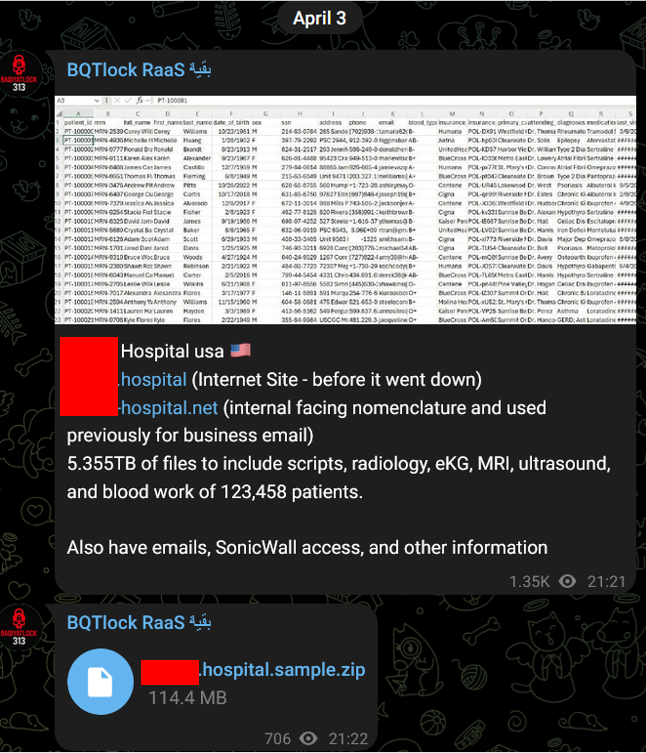
With the arrival of quantum threats, the same kind of data could be extracted from weakly encrypted network communications, without needing to compromise endpoints.
Network devices make up 11% of HDO devices and include routers, switches, firewalls and others that provide and manage connectivity for every type of asset on the network. Because they serve as traffic hubs for virtually all communications across the network, they uniquely provide access to large volumes of data moving through the environment. Routers directing network traffic between internal and external networks, such as the internet, VPN concentrators, and other choke points on the network handle much of the ingress and egress data. Currently, these devices are favored as initial access points by threat actors due to exploitable vulnerabilities. In the future, tapping these would allow threat actors to collect huge amounts of sensitive data, making them primary targets for HNDL attacks.
IoT and OT Devices
IoT and OT devices represent 18% of the risk surface in HDOs and are used for a wide array of functions from building automation to guest entertainment. These devices include the common VoIP phones and printers shown in the figure but also cafeteria and pharmacy point-of-sale systems, vending machines, ATMs, gift shop kiosks, physical security devices, smart building systems for energy and power management, HVAC, and backup generators. While these devices are not the primary concern when thinking about cryptographic risk in healthcare, some handle financial and other sensitive data – such as video conferencing systems.
These devices are often targeted by hacktivists when they are accessible online. Examples of real attacks, shown in the images below, include the pro-Russian hacktivist group Z-Pentest Alliance gaining control over – and tampering with – HVAC systems and IP cameras in Polish healthcare facilities.
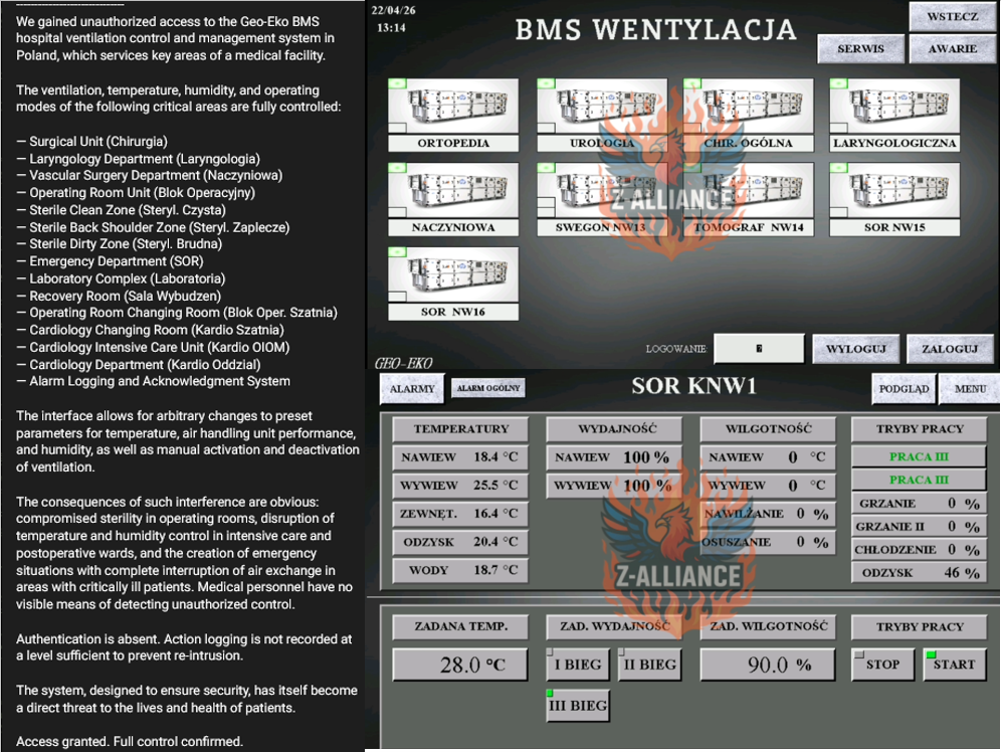
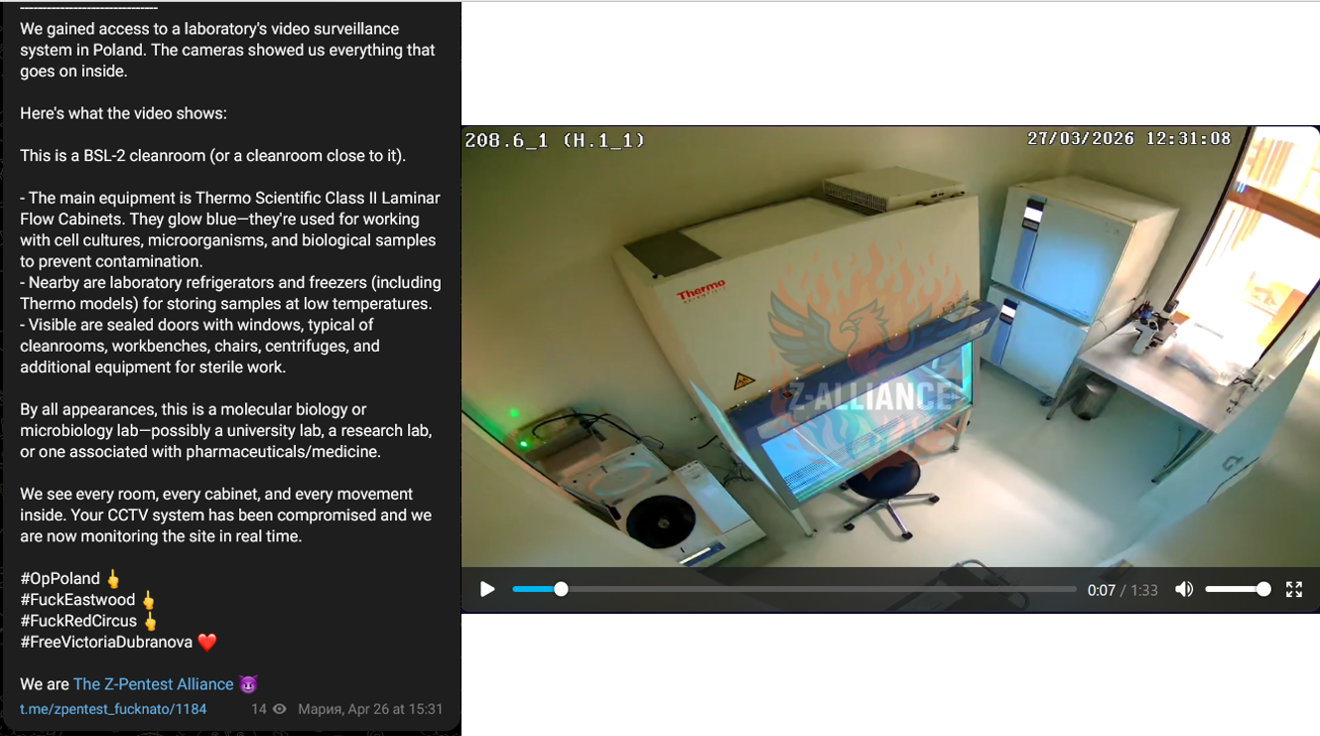
In most cases, these threat actors are not after data. They leverage control interfaces that either require no authentication or use default/weak credentials. In the future, sophisticated attackers with access to quantum computers could leverage quantum capabilities to decrypt strong credentials for these assets when they are communicated over the network.
Medical Devices
IoMT devices, used for patient monitoring and healthcare delivery, account for the remaining 5% of HDO assets. This gives a total of around 120,000 IoMT devices in our sample, an average of around 2,400 IoMT devices per HDO. These include connected medical devices in patient rooms, nurse stations, surgery centers, pharmacies, labs, and countless other locations. These devices may support clinical care, such as insulin pumps, heart defibrillators, ventilators, and any equipment saving or sustaining a life; or gather and monitor patient information such as vital signs and test results to alert and inform clinical staff. These include patient monitors, laboratory equipment, imaging devices, and more.
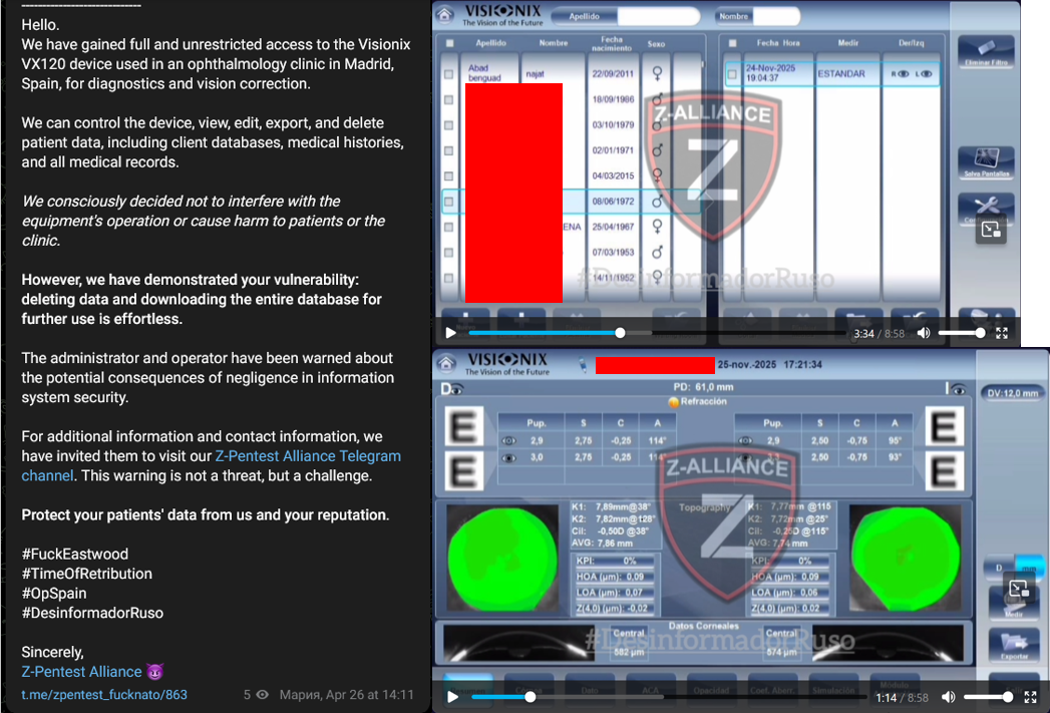
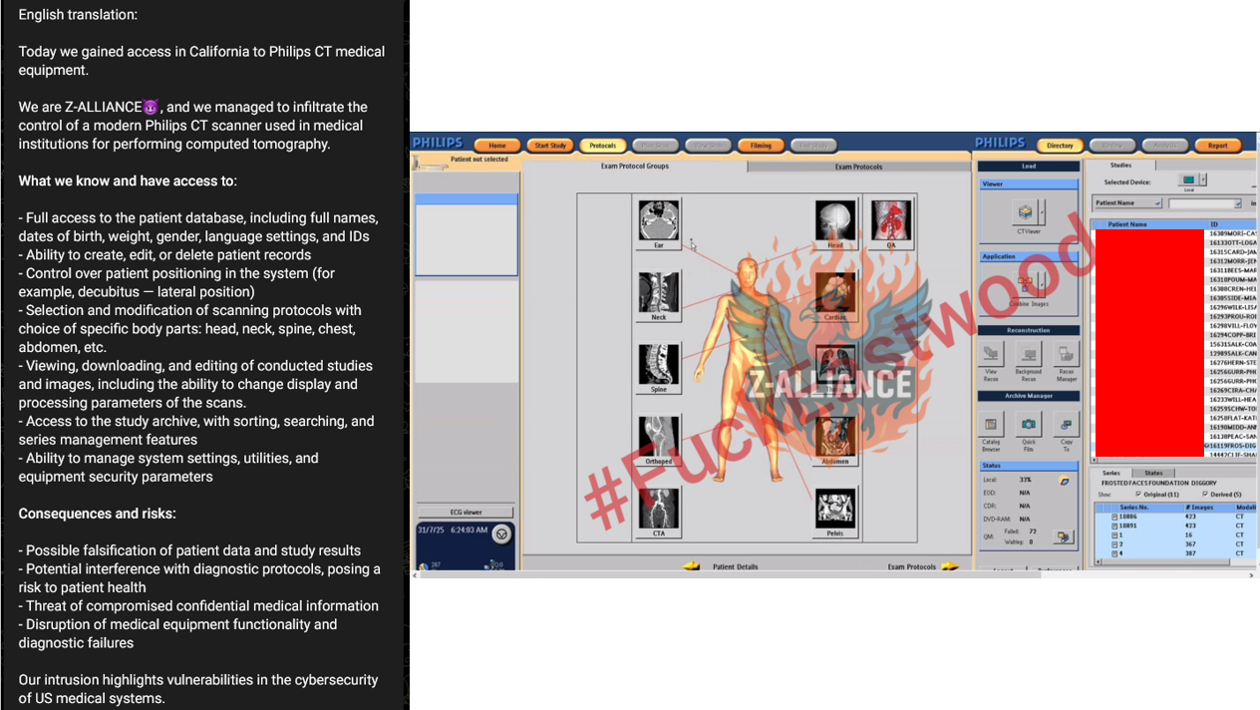
Again, these devices have been attacked by threat actors posting on Telegram how they can take control of exposed assets to intercept sensitive data or disrupt their functioning, such as in the examples below. Attackers usually describe how they can access patient databases with information such as full names and dates of birth; view, download or edit medical exams; and manage system settings.
Data at Risk
When discussing PQC migration in healthcare, it is not enough to discuss the types of devices that have to migrate their cryptographic implementations. HDOs must explicitly consider the heterogeneity of data types that these devices generate, transmit, store, and process.
HIPAA and other regulations mandate the use of appropriate administrative, physical, and technical safeguards for protected health information (PHI), including encryption where reasonable and appropriate. Clinical data such as electronic health records, imaging and lab results; operational data such as scheduled appointments; and real-time clinical data such as patient vital signs have distinct confidentiality, integrity, availability, and regulatory compliance requirements that directly influence cryptographic risk and migration urgency.
Long-lived, high-sensitivity data such as diagnostic images or patient records are prime candidates for HNDL attacks, while transient data streams such as session tokens may need to prioritize performance constraints over immediate cryptographic transition. Equally important, these data types are handled across a fragmented device landscape with different cryptographic capabilities, update mechanisms, and certification constraints.
Therefore, effective PQC migration requires mapping data classes to the specific device categories that generate, transmit, store, and process them, enabling risk-based prioritization and realistic deployment strategies aligned with both security requirements and operational limitations.
The table below lists several different data types in HDOs, their HIPAA category and common devices or systems that interact with this data. We will use this as a basis to understand what types of data in healthcare environments are most at risk today.
| Data Type | Examples | HIPAA Category (Why?) | Common Devices / Systems Interacting with This Data |
|---|---|---|---|
| Patient Identifiers | Full name, date of birth, patient ID, national ID | PHI (Direct identifiers are explicitly listed in HIPAA) | EHR/EMR systems, registration kiosks, front-desk workstations, hospital information systems (HIS), identity management systems |
| Contact Information | Address, phone number, email | PHI (Identifies the individual and relates to healthcare services) | EHR systems, patient portals, appointment scheduling systems |
| Insurance & Payer Data | Insurance ID, policy number, coverage details | PHI (Payment-related health information under HIPAA) | Billing platforms, clearinghouse portals, claims processing servers |
| Financial & Payment Data | Credit/debit card number, bank details, billing history | PHI + PCI (Dual regulated: payment data linked to healthcare services is PHI also subject to PCI DSS) | Payment terminals (POS), billing systems, third-party payment gateways |
| Clinical Observations (Vitals) | Heart rate, blood pressure, oxygen levels, temperature | PHI (Individually identifiable health information) | Bedside monitors, wearable medical devices, nursing station dashboards |
| Diagnostic Data | Diagnoses, ICD codes, clinical assessments | PHI (Core “health information” under HIPAA) | EHRs, clinical decision support systems (CDSS), physician workstations |
| Medication & Prescription Data | Medication name, dosage, administration schedule | PHI (Medication history is explicitly protected health info) | Pharmacy information systems, medication dispensing systems, smart infusion pumps |
| Laboratory Results | Blood tests, pathology reports, microbiology results | PHI (Diagnostic health information tied to a patient) | Laboratory information systems (LIS), EHR interfaces, results portals |
| Medical Imaging Data | X-rays, CT scans, MRIs, ultrasound images | PHI (Images often contain identifiers and clinical data) | PACS systems, imaging modalities, radiology workstations, imaging servers |
| Physician & Clinician Identifiers | Physician name, NPI number, specialty, role | Not PHI alone because it identifies provider. Becomes PHI when linked to a patient encounter | EHRs, identity and access management (IAM) systems |
| Treatment & Procedure Records | Surgical notes, care plans, progress notes | PHI (documents diagnosis and treatment of an individual) | EHRs, physician workstations |
| Medical Device Telemetry | Alarms, Performance metrics, uptime, therapy settings | Not PHI alone, may become PHI when tied to a patient (e.g., therapy settings) | Several IoMT devices and device gateways |
| Remote Patient Monitoring Data | Glucose levels, ECG data, vitals | PHI (Individually identifiable health data) | Wearables, home monitoring devices, mobile health apps, cloud monitoring platforms |
| Research & Clinical Trial Data (de-identified) | De-identified patient data, outcomes. Stripped of HIPAA’s 18 identifiers | Not PHI (Meets HIPAA de-identification standard) | Clinical data warehouses, research databases, analytics platforms |
| Operational & Scheduling Data | Appointment schedules, bed availability | PHI, if patient-linked. Not PHI, if not linked. | Scheduling systems, bed management systems, hospital operations dashboards |
| Public Health & Reporting Data | Disease reporting, vaccination records | PHI (permitted disclosure for public health purposes) | EHR reporting modules, public health interfaces, government reporting gateways |
The biggest quantum risk in healthcare is data traversing public networks, so beyond common assets and data types we need to understand what kind of healthcare systems are usually accessible online.
Medical devices are rarely connected directly to the internet, but they often communicate with information systems that are exposed. For instance, imaging modalities such as CT scanners communicate with picture archiving and communication systems (PACS), which in turn communicate with radiology information systems (RIS). Although CT scanners are not commonly found online, many PACS and some RIS are and thus may provide a path for attackers to access sensitive data from CT scanners.
Using a series of specific network fingerprints of medical systems (openly accessible to anyone, including attackers), we queried the Shodan search engine and found a total of over 5,500 instances of 50 different medical information systems exposed. As the figure below shows, the vast majority of these were either EMR (46%), storing medical records, or PACS (40%), storing medical images. Laboratory management systems, storing exam results, and medication dispensing systems, storing information about prescribed drugs are also among the most exposed.
Vulnerable PACS systems – those lacking proper authentication and encryption – are a persistent risk and we have explored real attacks targeting data from those systems in previous research. Here, we draw attention to the fact that even for those PACS that use encryption, only 36% use TLSv1.3, the only version that supports PQC. The situation is similar for EMR (33% using TLSv1.3) and worse for laboratory management systems (13%) and others.
Across every type of exposed medical system, the average percentage of TLSv1.3 deployments is 31%. Even worse, 15% of systems still support TLSv1 or TLSv1.1, which are officially deprecated and disabled in modern browsers, due to lack of support for modern cryptographic algorithms, even before PQC.
Internet-Exposed Medical Systems
Internet-Exposed Medical Systems
Percentage of TLSv1.3 Deployments Across Internet-Exposed Medical Systems
Prioritizing Risk
Healthcare data most at risk for quantum attacks is that which:
- Is commonly transported over TLS or other cryptographic protocols using quantum-unsafe RSA or elliptic curve cryptography (ECC) for authentication and key establishment today
- Has long confidentiality lifetime, making HNDL attacks relevant
- Is likely to be recorded or intercepted when traversing external networks, including the internet, partner links, remote access solutions, cloud applications and others
This definition excludes some data types from Table 1, such as short-lived transactions that have low value once clinical context expires (e.g., the medical device telemetry), and information communicated over unencrypted legacy protocols, such as HL7v2, POCT01, LIS and others. The latter is already a confidentiality and integrity risk today, not a future one. However, this kind of traffic is usually limited to internal networks. See our previous research for examples of attacks leveraging unencrypted data in healthcare networks.
Combining the three datasets above – common assets, data and exposure in healthcare systems – with this definition of quantum risk, Table 2 shows the five data types currently most at risk for quantum attacks in HDOs:
| # | Data Type | Why Is It Risky? |
|---|---|---|
| 1 | EHR / EMR | EHRs/EMRs often include complete clinical histories with patient identifiers, diagnoses, medication, lab results, appointment scheduling and other information. The data is presented on Internet-facing patient portals and communicated via APIs on Health Information Exchange (HIE) systems transporting it over TLS. Traffic traverses many boundaries, is easy to harvest on public networks and highly valuable long term. |
| 2 | Medical Imaging | Medical images contain metadata with lifelong sensitivity. They can be used for extortion (patient shaming) and are routinely included in cybercriminal data leak samples. This type of large volume data is often transferred across sites (e.g., replicated to clouds and teleradiology providers) using the DICOM protocol, which is by now well-known to attackers, and stored or accessed via PACS. |
| 3 | Laboratory Results | Laboratory results are commonly communicated across different institutions because reference laboratories perform complex, specialized or high-volume diagnostic testing that local HDOs cannot do. This includes not only clinical and commercial labs but also public health systems that investigate outbreaks or rare diseases. Lab results may contain very sensitive data such as biomarkers for HIV, cancer and other diseases, toxicology or drug screening results and genetic data. |
| 4 | Medication & Prescription Data | Medication data including medication history and use of controlled substances is not only generated and stored internally in HDOs, but also communicated via electronic prescribing (eRx) systems. These systems facilitate prescription, insurance verification and medication messaging between healthcare providers and retail pharmacies, so the data can traverse public networks and is particularly sensitive in cases of addiction or chronic diseases. |
| 5 | Financial/Payment Data | Not healthcare-specific but valuable data for attackers for immediate monetization. Can be captured when on-site PoS or billing systems communicate with external payment processor gateways or when patients enter financial information in patient portals and other systems. |
Recommendations
Healthcare organizations and patients alike should not treat quantum risk and PQC migration as distant theoretical issues. The ingredients for quantum exposure already exist today: large volumes of long-lived, high-value data; widespread dependence on protocol implementations that are not yet PQC-capable; and thousands of internet-exposed healthcare systems that store or transport some of the sector’s most sensitive information. In practice, the greatest near-term concern is not that quantum attacks are already happening – since cryptographically relevant quantum computers are not yet available – but that adversaries can harvest encrypted healthcare traffic now and retain it until quantum decryption becomes feasible.
This report elucidates how this risk is unevenly distributed. Traditional IT systems still hold the bulk of patient and business data and remain the most likely targets for ransomware, data theft, and future attacks. However, network infrastructure, internet-facing medical information systems, and specialized devices are also critical because they move, expose, or mediate access to sensitive data and are slower to migrate to PQC. The data most at risk today is that which is both easy to intercept and valuable for years: EHR and EMR records, medical imaging, laboratory results, medication data, and financial information. These are precisely the datasets that cross organizational boundaries, traverse public networks, and often depend on cryptographic stacks that will be slow to migrate.
To be able to migrate their assets before quantum attacks become feasible, HDOs need to first inventory their systems, identify choke points such as partner interconnections and internet edge devices, understand which support PQC or not, assess the risks they are exposed to and what can be done to mitigate these risks.
The main operational constraint for the migration is crypto-agility. Where organizations control the TLS or VPN termination points and software stacks, migration can move relatively quickly. In other cases, it’s a much bigger challenge. High-agility environments include IT systems under direct administrative control. Medium-agility environments involve shared ownership, such as partner-managed endpoints and vendor appliances. Low-agility environments include legacy proprietary systems, regulated medical devices, and gateways where cryptographic changes depend on vendor release cycles, recertification, or even hardware replacement.
This is why healthcare PQC planning cannot be reduced to a device or protocol checklist. It requires understanding which assets can be easily upgraded, which cannot, and what sensitive data each one protects. Below is a list of actions that HDOs can take in the upcoming months to prepare for this migration and ensure they will be well-positioned once either this becomes mandated or quantum attacks become practical:
Next 6-12 Months
- Use this report as an example to map your own terrain, identify common assets, data types, internet exposure and risk in your networks.
- Prioritize internet-exposed connections, such as patient portals, external-facing APIs, VPN gateways, and inter-organization data exchange.
- Enforce TLSv1.3 wherever possible.
- Update internal governance and risk frameworks by integrating PQC into threat models and aligning with transition guidance.
- Define PQC KPIs, such as percentage of assets that are PQC-capable or number of flows with sensitive data that are quantum-safe.
- Identify which assets can or cannot be updated to support PQC and plan their updates.
2-24 Months
- Update crypto libraries/applications, such as OpenSSL or OpenSSH, and device firmware where possible to support PQC.
- Segment and isolate legacy systems that cannot be updated.
- Plan for PQC gateways and secure remote access (SRA) solutions in front of legacy systems and network segments that cannot be updated.
- Engage vendors to understand PQC roadmaps for those that have not yet offered alternatives.
- Consider including PQC requirements or clear roadmaps into procurement decisions and contract renewals.
- Start measuring the PQC KPIs defined previously.
24+ Months
- Continuously measure the PQC KPIs against objectives in each identified network segment.
- Consider replacing those assets that have no clear roadmap for the migration.
- Identify further risk mitigation measures for those network segments considered risky containing assets without vendor-provided migration roadmaps and that cannot be replaced.