Guide
A Practitioner’s Guide to Universal Zero Trust Network Access (UZTNA)
A practical implementation roadmap for security architects, network engineers, and CISOs.
Foreword
I have spent most of my career watching Zero Trust get explained, sold, and then misapplied. The model itself is sound — it has been sound since John Kindervag put it on paper and NIST formalized it in SP 800-207. What broke is the gap between the theory and the deployments. Most organizations adopted the vocabulary, bought the products, and stopped one or two steps short of the outcome. Then 2020 happened, the workforce went remote overnight, and the market compressed Zero Trust into a single use case: replacing the corporate VPN. ZTNA shipped, the remote-access problem got better, and the harder majority of the estate — on-prem applications, service-to-service traffic, IoT and OT — got left behind.
That gap is what this guide is about. Universal Zero Trust Network Access is not a new acronym to memorize or a new product category to procure. It is the discipline of applying Zero Trust the way it was originally specified: to every user, every device, every workload, every access path, with no exceptions. The word ‘universal’ is not marketing. It is the acceptance criterion that separates a Zero Trust program from a Zero Trust press release.
I wrote this as an operator’s manual because operators are who I work with. The architects, the network engineers, the identity leads, and the CISOs who have to stand in front of an audit committee and explain why a contractor’s laptop could reach a production database. None of those people need another market guide. They need a sequenced playbook that tells them what to build, in what order, with what exit gates, and what to refuse to ship. That is what I have tried to put in your hands.
You will notice the guide is opinionated. It is supposed to be. Wherever I have seen the same wrong turn taken five times in a row, I called it out — in the chapter text, in the ‘Don’t Do This’ boxes, and in the vendor red flags. Treat those as scar tissue from other people’s programs so that they do not have to become scar tissue in yours.
One last note. UZTNA, like Zero Trust before it, is a program rather than a project. The organizations that treat it as a one-time deployment will be the ones I get called about after the breach. The ones that treat it as an operating discipline will not need to call. My hope is that this guide tilts you toward the second group.
— Dr. Chase Cunningham
DrZeroTrust | July 2026
How to Use This Guide
This is an operator manual, not a market report. Each chapter answers two questions: what do you build and in what order. Theory is kept to the minimum needed to make the next decision. Background research, citations, and reference material live in the appendices.
Who is This for:
- Network architects and security engineers building or extending a Zero Trust program.
- CISOs scoping investment, sequencing, and accountability.
- IT operations leaders who own rollout, change management, and day-two.
How to Read It:
- Read Chapters 1–2 once for a shared language and a readiness baseline.
- Use Chapters 3–6 as a sequenced playbook. Do them in order.
- Use Chapter 7 as your day-two operating handbook.
- Treat appendices as quick-reference lookups not required reading.
Chapter 1 – What UZTNA Is (and Isn’t)
Universal Zero Trust Network Access (UZTNA) is what Zero Trust was always supposed to be: a program for securing the full scope of what is on or connects to your network. When NIST published Special Publication 800-207, the reference framework deliberately covered every environment in scope: users, workloads, devices, networks, and the boundaries between them. It was a model for the entire estate. Then, the pandemic hit and the market reorganized around a single ZTNA use case for remote work: replacing the VPN for off-network users. That solved a real problem, but it left the rest of the original spec on the shelf.
UZTNA is the work of putting it back.
In practical terms, UZTNA extends the same enforcement model across every access path the organization runs. Strong identity. Verified device posture. Continuous evaluation of context. And, least-privilege access to specific applications. Remote users, on-prem users, branch offices, cloud workloads, SaaS, contractor laptops, unmanaged devices, IoT sensors, specialized medical devices, and OT systems are all in scope. No one product does all of that. But with UZTNA, the same policy regime, evaluated against the same identity and posture signals, governs all of it.
Universal ZTNA vs. Traditional ZTNA
A comparison of scope, coverage, and enforcement.
| Dimension | Traditional UZTNA Solves a Narrow Use Case | Universal UZTNA Secures the Full Scope |
|---|---|---|
| Scope | Remote / off-network users | All users — remote, on-prem, hybrid |
| Devices | Managed endpoints | Managed + unmanaged + IoT / OT |
| Policy Plane | Multiple enforcement points | Centralized policy decision point with federated enforcement points |
| Apps Covered | Cloud and SaaS | Cloud + on-prem + legacy |
| Verificaion | At authentication | Continuous, context-aware |
| VPN Role | Coexists | Replaced |
Traditional ZTNA solved remote access. Universal ZTNA extends the same enforcement model to every user, every device, every workload, and every access path – with no exceptions.
The Five Universals
The Five Universals below are the acceptance criteria for any UZTNA deployment. They are written as outcomes rather than features so that you can use them to evaluate a design, a vendor demo, or your own production state without getting trapped in product taxonomy. If a proposed deployment cannot meet all five, it is not UZTNA; it is partial Zero Trust with a more ambitious label.
1. Universal Identity Verification
Every actor in the environment – human users, service accounts, machine identities, workload identities – authenticates against the same trust model, even though the specific method varies by identity type. A human user might present a FIDO2 credential. A workload might present a SPIFFE ID and a short-lived token. Both events are evaluated by the same policy engine, against the same standard of evidence, and logged to the same audit trail. The form of the authentication is allowed to differ; the rigor is not.
Acceptance Criteria: All actors authenticate against the same trust model, regardless of identity type.
2. Universal Device Posture Assessment
Every endpoint touching the environment produces a trust signal, including endpoints the organization does not own. Managed corporate laptops carry an EPP/EDR agent and a device certificate. Unmanaged contractor devices are evaluated through an agentless browser-based channel. IoT and OT devices are identified by certificate where possible and by compensating signals where not — MAC address, switch port, protocol fingerprint, passive discovery. The deployment is not allowed to ignore a class of device because it is inconvenient.
Acceptance Criteria: Every endpoint produces a trust signal; no class of device is excluded.
3. Universal Policy Enforcement
A centralized policy decision point governs access across cloud, on-prem, and hybrid environments. The honest version of this in 2026 is that most organizations run a coordinated set of policy planes rather than a single physical one — with identity, posture, and risk signals shared across them. A single unified plane is the directional goal. The day-one reality is a consistent decision model implemented across a small number of enforcement surfaces. Either is acceptable. But what isn’t acceptable are two policy regimes that disagree on the definition of ‘least privilege’.
Acceptance Criteria: Policy is decided once in a centralized plane; there are no conflicting policy regimes.
4. Universal Application Access
The same access broker, evaluated against the same policy, protects SaaS, cloud-hosted applications, on-prem private applications, and legacy systems. The ‘universal’ adjective excludes the common shortcut of solving cloud access with one product, on-prem access with another, and legacy systems with a permanent exception. If the legacy mainframe sits behind a different policy regime than the modern SaaS HRIS, the program is not yet universal.
Acceptance Criteria: All applications – SaaS, cloud, on-prem, and legacy – are protected by the same access broker and policy.
5. Universal Continuous Monitoring
Trust is re-evaluated on every request rather than only at session establishment. A user who authenticated cleanly at 08:00 and whose device posture degraded at 09:30 — because the EDR agent stopped reporting, or the disk encryption was disabled, or the device left a trusted location, should lose access in seconds, not at the next scheduled re-auth. Continuous verification with dynamic enforcement is foundational to Zero Trust. Without it, you have rebuilt a VPN with better paperwork.
Acceptance Criteria: Trust is re-evaluated on every request, not just at session start.
Where UZTNA Fits Next to SASE, SSE, and ZTA
Three adjacent terms get confused with UZTNA, often in the same vendor slide. ZTA, as defined by NIST SP 800-207, is the architectural model itself; UZTNA is one concrete implementation of it. Security Service Edge (SSE) is the cloud-delivered security stack that contains UZTNA along with secure web gateway, CASB, and data-loss prevention; UZTNA delivers the application access function inside that stack. SASE bundles SSE with SD-WAN and is a network-architecture pattern rather than a security model. UZTNA can ship inside an SSE or SASE platform or it can be deployed as a standalone access layer alongside an existing SSE/SASE stack. The point is that UZTNA is complementary to these categories, not a rival to any of them.
Universal ZTNA: A Complementary Access Layer
Three layers working together to deliver one Zero Trust outcome.
| Universal ZTNA Access Enforcement Layer | SSE Security Services Layer | SASE Network Architecture Layer |
|---|---|---|
| One concrete implementation of Zero Trust Architecture that delivers the universal access function. Determines who or what is trusted and what they can access. | The cloud-delivered security stack that contains UZTNA along with secure web gateway, CASB, and data-loss prevention. | Bundles SSE with SD-WAN. A network-architecture pattern rather than a security model. |
| Who & What Can Access | What is Protected | How It is Connected |
Universal ZTNA is complementary to these categories, not a rival to any of them.
Operator Action Items
Three actions are worth taking before you read any further.
- First, adopt the Five Universals as the written acceptance criteria for your program. Put them in the charter. Reference them in vendor evaluations. Cite them when a business unit asks for an exception.
- Second, document the gap between where your current ZTNA deployment stops and where UZTNA needs to reach. This gap is your program scope.
- Third, name the executive sponsor who will personally enforce the ‘no exceptions’ rule.
- The failure mode of every UZTNA program is the accumulation of small exceptions that no one is willing to refuse.
Don’t Do This
- Treat “we deployed ZTNA for remote users” as a finished zero trust program.
- Let any business unit declare itself an exception to universal enforcement.
- Buy a vendor labeled “universal” without verifying on-prem and IoT coverage.
Chapter 2 – Readiness Assessment (Do This First)
Skip this chapter and you will end up redesigning mid-rollout. The most expensive UZTNA programs are the ones that picked a vendor, drafted a timeline, and discovered within six months that the application inventory was wrong, identity was still federated across three directories, or the OT network had never been mapped. All of those failures are diagnosable in advance. The readiness assessment below is the cheapest insurance policy in the entire program.
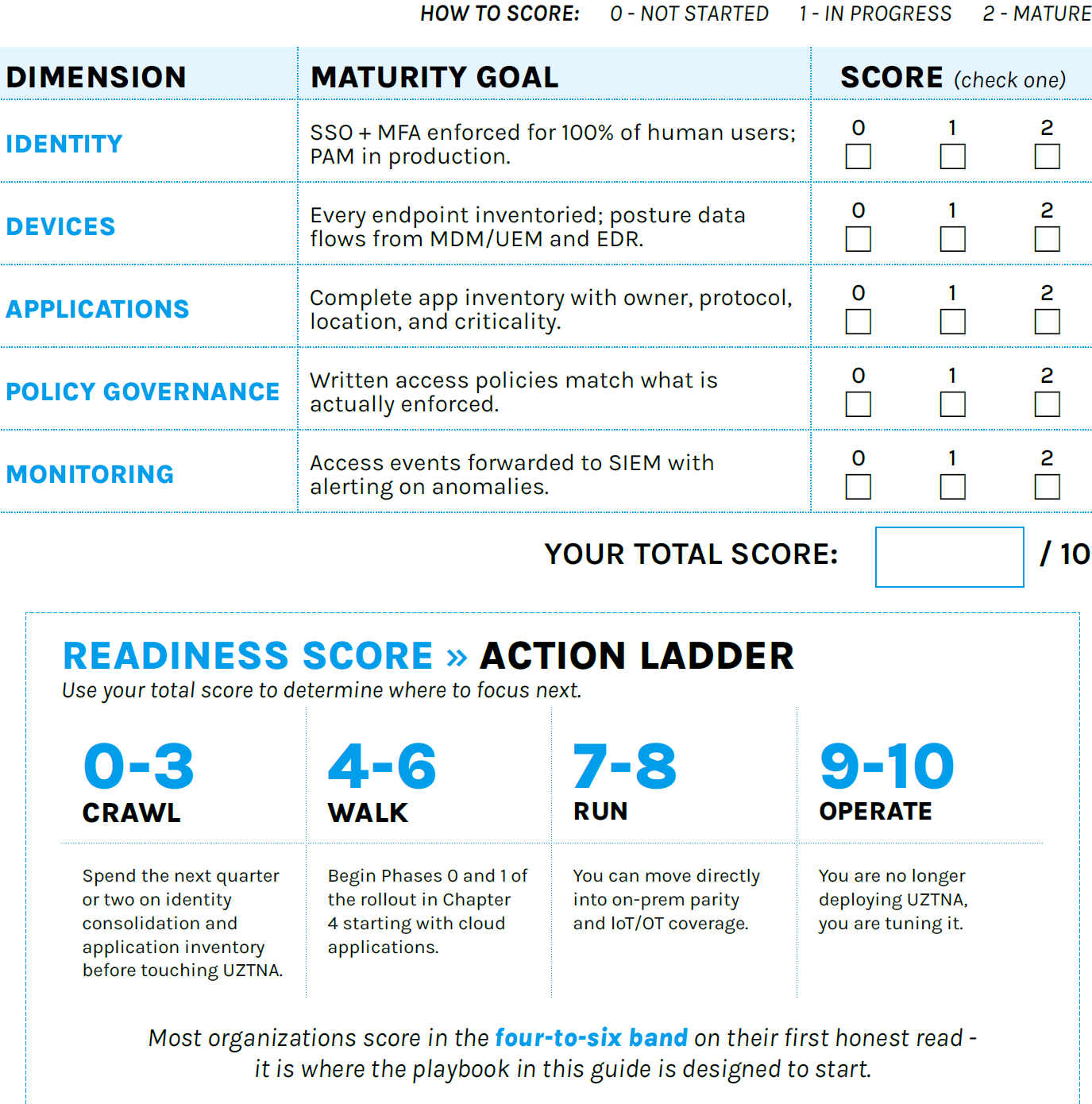
UZTNA Readiness Scorecard
Score yourself honestly on the five dimensions in the table. Use a simple zero-to-two scale: zero for ‘not started,’ one for ‘in progress,’ two for ‘mature’ and sum the result. Honesty matters more than precision. A program that scores itself dishonestly will rebuild the deltas the hard way, in production, on a vendor’s clock.
Stakeholders that Need to Be in the Room Before Day One
Six roles must be present before Day One
- The CISO is the sponsor and the tiebreaker.
- The network and security architects own the design.
- The identity team owns IdP, PAM, and directory work.
- The application owners for the top twenty business-critical applications own migration and testing for those apps.
- The compliance and audit lead owns control mapping and evidence collection.
- The help desk lead owns change management and the userexperience side of every cutover.
If any of those seats are empty when the program kicks off, the corresponding workstream will stall by Phase 2.
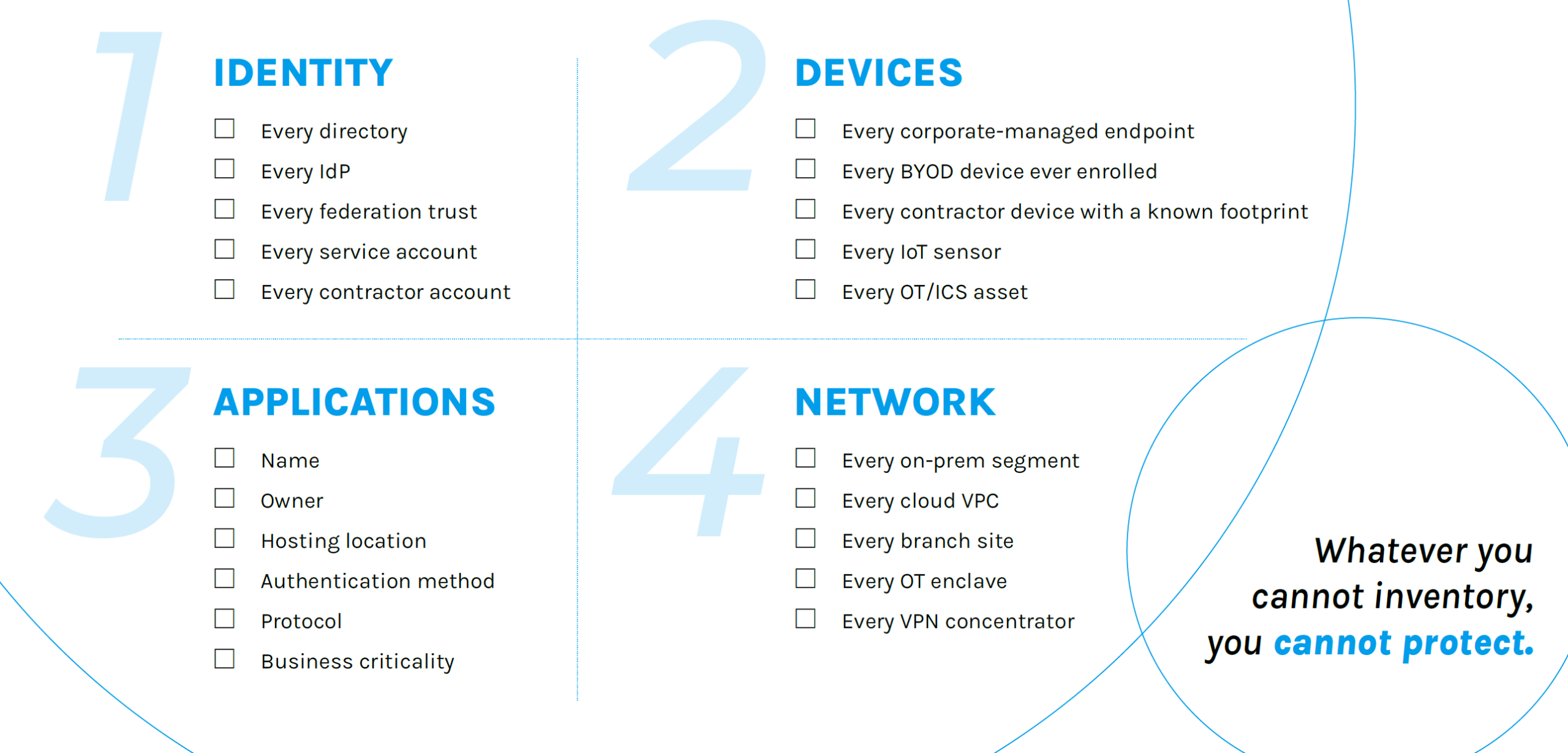
Inventory Checklist
Before Day 1 you need a complete inventory across four domains. No shortcuts. On the identity side, catalog every directory, IdP, federation trust, service account, and contractor account. On the device side, capture every corporate-managed endpoint, BYOD device ever enrolled, contractor device with a known footprint, IoT sensor, and OT/ICS asset. On the application side document name, owner, hosting location, authentication method, protocol, and business criticality for every application including the ones nobody admits to running. On the network side, map every on-prem segment, cloud VPC, branch site, OT enclave, and VPN concentrator. Whatever you cannot inventory, you cannot protect.
Common Gaps that Kill Implementation
Four gaps kill more UZTNA programs than every vendor limitation combined.
- Incomplete application inventory: You cannot protect what you have never catalogued.
Impact: The missing applications are always the sensitive ones. - Legacy applications without migration plans: Legacy applications with no identity-aware access path and no migration plan.
Impact: These become the permanent exceptions that erode the whole ‘universal’ premise. - Unmanaged endpoints without owners: Unmanaged endpoints that no one owns operationally.
Impact: If no team is accountable for a device class, no policy will be enforced on it. - Unclear policy ownership: Unclear policy ownership between security, network, and application teams.
Impact: Surfaces as ‘whose change ticket is this?’ and stalls every cutover.
Name owners for each before you start. The earlier these are resolved, the faster and smoother your UZTNA rollout will be.
Don’t Do This
- Skip the readiness scorecard because “we already know where we are”.
- Sign a vendor contract before completing the application inventory.
- Leave one of the five readiness dimensions without a named owner.
Chapter 3 – Reference Architecture
Every UZTNA deployment breaks down into the same logical components regardless of the vendor. The labels differ but the shape is identical — one vendor’s ‘connector’ is another’s ‘gateway’ is another’s ‘proxy’. Map your design against the reference diagram below before procurement so that you know which components a given vendor actually delivers and which you will have to bring yourself.
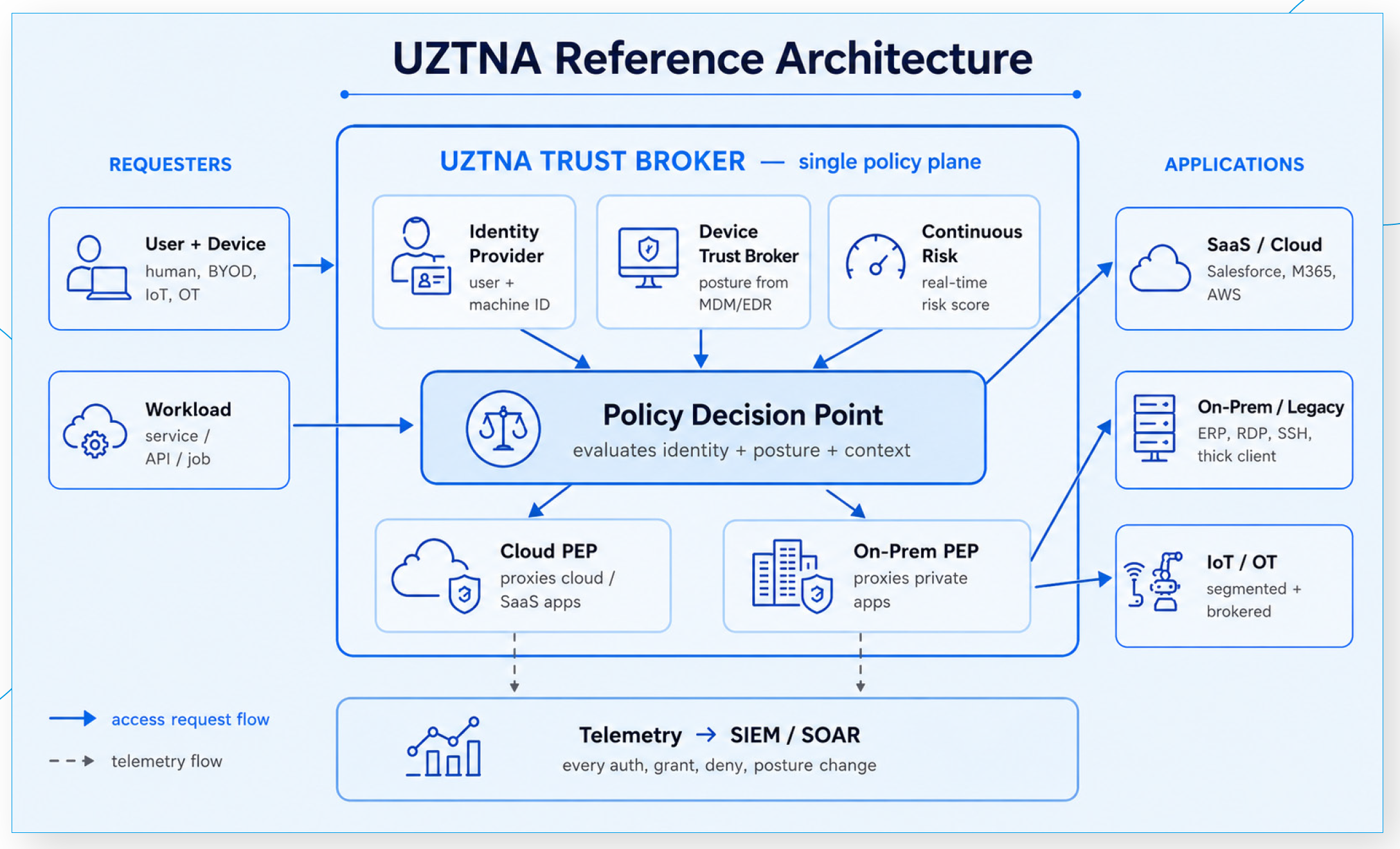
Figure 1. The UZTNA logical architecture, vendor-neutral. The PEPs shown here (reverse proxies and private-app connectors) are not appropriate for every workload class. OT, ICS, and many IoT segments require network-level enforcement instead; see the device-trust table in Chapter 5 for the per-class control mapping.
Core Components (Every Deployment Needs All of These)
- Identity Provider (IdP): Source of truth for user, group, and machine identity.
- Device Trust Broker: Collects posture signals and produces a per-device trust score.
- Policy Decision Point: Evaluates identity + posture + context against policy.
- Policy Enforcement Points: Cloud and on-prem proxies that allow or deny access.
- Application Connectors: Reverse proxies / connectors that publish apps without exposing the network.
- Continuous Risk Engine: Re-scores sessions in real time and triggers step-up or revocation.
- Telemetry Pipeline: Forwards access events to SIEM/SOAR for detection and audit.
Architecture Rules You Cannot Skip
Five architectural rules do not bend.
- The first is sequencing on segmentation. Start with network-based macro-segmentation before UZTNA: separate production from corporate, OT from IT, regulated workloads from general-purpose. Then, progressively tighten toward application-level micro-segmentation as identity and posture data mature. Segment by application identity, not by IP range. A concrete example: isolate the finance ERP into its own segment where only the finance-admin identities can reach it, rather than allowing other departments and non-finance roles access.
- The second rule is that east-west traffic is a prerequisite, not a Phase 4 problem. If service-to-service calls inside the data center are unpoliced, then a single compromised workload owns the blast radius regardless of your front door’s strength.
- The third rule: legacy applications need an explicit handling plan that includes a protocol-aware proxy, header injection, or a controlled exception with an expiration date. The choice is yours; the absence of a choice is not.
- The fourth rule is the IoT/OT plan. For devices that can hold a certificate, use certificate-based device identity plus network-level segmentation. For legacy and constrained devices that cannot, use compensating identifiers – MAC address plus switch port plus protocol fingerprint – combined with passive discovery and brokered access through a jump host or protocol-aware proxy. Plan for the OT estate reality that most agents will not exist.
- The fifth rule is the vendor-evaluation lens. Score every vendor on the depth of its IdP, SIEM, and EDR integrations, and treat API-first as a hard requirement. A vendor that cannot be driven by API will become an operational bottleneck no amount of pricing concession can fix.
Deployment Model: Pick One Per Workload Class
UZTNA supports multiple deployment models. Choose the model that best fits each workload class.
| Cloud-Delivered | On-Prem Enforcement | Hybrid | |
|---|---|---|---|
| Use When | Most workloads, hybrid workforce, SaaS-heavy estate. | Air-gapped, regulated, or latencysensitive environments. | Cloud policy plane with on-prem PEPs near workloads. |
| Tradeoff | Best operations, dependency on vendor cloud. | More infra to run; required for some compliance regimes. | Most flexible; demands disciplined operations. |
Never connect users to the network. Connect them only to the specific application they are entitled to, after identity, posture, and policy have all been satisfied.
Don’t Do This
- Run two policy planes in parallel ‘temporarily’. Temporary becomes permanent.
- Deploy UZTNA before micro-segmentation. You will have to redo it.
- Pick a deployment model based on vendor preference instead of workload reality.
Chapter 4 – Phased Rollout Playbook
Run the phases in order. Each phase has an exit gate, and you do not start the next phase until the previous gate is met. The gates exist because every UZTNA program that has skipped one has paid for it later, usually in the form of a rebuild during Phase 3 or 4 when something foundational was assumed rather than verified.
Phase 0: Assess and Align (Weeks 1-4)
About alignment more than deployment. Complete the readiness scorecard from Chapter 2. Draft the ‘no exceptions’ policy statement and require your CISO to sign it personally. Verbal endorsement does not survive the first vendor exception request. Pick a pilot user group of 50 to 200 users spanning at least two business units (or functions) because a single-business-unit pilot will miss the cross-functional policy edges that matter most.
What Success Looks Like
- Readiness scorecard complete
- No-exceptions policy signed by CISO
- Pilot user group selected (50-200 users, 2+ BUs)
- Sponsor named; stakeholders committed
Phase 1: Identity & Device Foundation (Months 1-3)
Builds the identity and device foundation that the rest of the program rests on. Federate every application you can to a single primary IdP and eliminate local accounts on each system as it federates. Enforce phishing-resistant MFA. This is the place to be prescriptive: disable SMS-based OTP which remains the most commonly deployed second factor and the easiest to phish or SIM-swap. Require, in order of preference, FIDO2 credentials and passkeys, then platform provided biometric authenticators (ie: Windows Hello, Touch ID, Face ID), then push-based authenticator apps with number matching and biometric unlock. Voice OTP and email OTP are not acceptable second factors. In parallel, stand up the device trust broker and wire it to your MDM, UEM, and EDR feeds, and issue device certificates from your PKI for every managed endpoint.
What Success Looks Like
- All applications federated to a single primary IdP
- Phishing-resistant MFA enforced (FIDO2/passkeys)
- Device trust broker wired to MDM, UEM, EDR
- Device certificates issued from PKI
Phase 2: Cloud App Migration (Months 2-5)
Migrates cloud and SaaS applications behind the UZTNA proxy. Publish each application in shadow mode first, where the broker logs but does not enforce the policy decision. Promote an application to enforcement only after seven consecutive days of clean logs — no unexplained denies, no posture drift, no policy exceptions accumulating. Migrate the pilot user group off the VPN for those applications as each one cuts over, so that you build a track record of clean cutovers before scaling.
What Success Looks Like
- All cloud/SaaS apps published behind UZTNA proxies
- Each app tested in shadow mode first
- Seven consecutive clean-log days before enforcement
- Pilot users migrated off VPN as apps cut over
Phase 3: On-Prem Parity (Months 4-8)
Where most programs hit their hardest stretch: bringing on-prem applications under the same policy regime that already governs cloud and SaaS. Deploy on-prem application connectors in high-availability pairs near the workloads they front. Move the top 20 internal applications behind UZTNA first, starting with HR, finance, and engineering tooling. Those three categories are chosen deliberately. They cover the highest-value data — HR PII, financial systems of record, source code, and build infrastructure. They draw the most active audit attention. And they exercise the broadest set of access patterns — human, service account, and CI/CD workload — which surfaces policy gaps early when they are still cheap to fix. As each application cuts over, eliminate the matching VPN entitlement on the same day.
What Success Looks Like
- On-prem apps under same policy regime (single PDP, federated PEPs)
- On-prem connectors deployed in HA pairs
- Top 20 internal apps behind UZTNA (HR, finance, engineering)
- VPN entitlements eliminated same day as cutover
Phase 4: IoT/OT Coverage (Months 6-12)
Extends coverage to IoT and OT. Inventory every device by segment and protocol because you cannot apply a policy to a device class you have not seen. Apply network-level micro-segmentation as the primary control. For most OT devices, segmentation is the only control you will ever have. Issue device certificates where the hardware supports them; otherwise wrap with brokerfronted access through a jump host or protocol-aware proxy. Every exception that survives this phase must be documented with a named owner, a compensating control, and an expiration date. Unexpired exceptions are how OT environments accumulate the decade-old vulnerabilities that show up in breach disclosures.
What Success Looks Like
- Every device inventoried by segment and protocol
- Network-level micro-segmentation applied
- Certificates issued or broker-fronted access via jump host
- Every exception documented (owner, control, expiry)
Phase 5: Validate & Optimize (Ongoing)
The ongoing work. Run quarterly policy reviews and retire any rule that has been in shadow mode for more than a quarter or that has not matched a request in ninety days. Tune the risk engine to reduce false positives without
softening enforcement — false-positive fatigue is the most common path to enforcement-mode rollback. Advance one rung of the maturity model each quarter (see Chapter 7) and treat that advancement as a board-reportable metric, because what is not measured will not be improved.
What Success Looks Like
- Quarterly policy reviews conducted
- Unused rules (90+ days) retired
- Risk engine tuned to reduce false positives
- One maturity rung advanced per quarter
Migration Discipline: Kill the VPN
The discipline for killing the VPN is straightforward and unforgiving. Inventory every VPN entitlement and map each one to a specific application. Migrate applications in waves. On the same day an application cuts over to UZTNA, remove the matching VPN entitlement. Track ‘percent of access migrated off VPN’ as a programlevel KPI and report it to the board on a quarterly cadence. Operational migration metrics belong to the project, but the trend line and the VPN sunset date belong to the board.
Set that hard sunset date for the VPN concentrator and publish it internally because a published date concentrates minds in a way a private one does not.
Always-On Guardrails
- Run Every New Policy in shadow mode before Enforcing it.
- Maintain a documented rollback for every change
- Keel parallel VPN access available for one wave behind the active migration and decommission only after the new wave had run stably.
- Communicate every cutover to affected users on a seven-day, three-day, and one-day cadence; the user-experience complaints that kill programs are almost always preceded by inadequate notice.
Don’t Do This
- Make a hard cutover from VPN to UZTNA in a single weekend.
- Promote a policy from shadow mode to enforce without seven clean days of logs.
- Skip a phase “because we already covered the cloud apps”.
Chapter 5 – Identity & Device Controls
Identity is the perimeter. Device posture is the second factor. Together they decide whether any access request gets evaluated at all, which is why this chapter comes before policy and application access — get identity and posture wrong and no amount of clever policy will save the program.
Identity – Required Configurations
On the identity side, five configurations are non-negotiable.
- Designate one primary IdP as the authoritative source of identity and federate everything else to it wherever supported (Okta, Entra ID, or Ping are the common choices). Where a target system does not integrate with your IdP, document the exception, wrap it with a proxy or PAM session that does, and put it on a remediation roadmap rather than accepting it as a permanent gap.
- Enforce phishing-resistant MFA for every human user, FIDO2 credentials or passkeys.
- Configure conditional access policies that bind to device posture, location, and session risk score; static role membership alone is not sufficient.
- Require step-up authentication for any access to sensitive or privileged resources, so that the elevation event is itself a fresh trust decision.
- And integrate PAM with the UZTNA proxy so that privileged sessions are just-in-time, scoped, and recorded end-to-end.
Non-Human Identity: The Most Overlooked Attack Surface
Non-human identity is the most consistently overlooked attack surface in modern estates.
- Inventory every service account, API key, and workload identity, and put them in the same identity store you use for humans rather than a parallel spreadsheet.
- Adopt a workload identity model for service-to-service authentication (SPIFFE/SPIRE or a cloud-native equivalent), so that workload identity is cryptographic rather than network-derived.
- Place API gateways inside the UZTNA enforcement plane for east-west API calls because an unprotected east-west API is the lateral-movement path attackers will use once the front door is difficult.
- Rotate secrets automatically; long-lived static credentials should be treated as an audit finding under SOC 2 CC6, PCI DSS 8.3, and NIST SP 800-53 IA-5, and remediated on a defined timeline rather than left in place indefinitely.
Device Trust Spectrum: Plan a Control for Each Tier
Different device classes need different controls; the table below maps each class to the primary control and the acceptable risk posture. The principle behind the table is that the access-grant decision should be a function of what the device actually is and what it can prove about itself, not a binary ‘managed vs. unmanaged’ classification that drops half the estate into the unmanaged bucket.
| Primary Control | Risk Posture | |
|---|---|---|
| Fully Managed Corporate | Agent-based posture + device cert + MDM. | Full access per policy. |
| BYOD Enrolled | Lightweight agent or MDM profile; cert-based identity. | Limited access: sensitive apps require step-up. |
| Unmanaged Contractor | Agentless, identity-bound browser access with remote browser isolation (RBI). | Time-limited, scope-limited grants only. |
| IoT | Network segmentation + certificate identity where possible. | Network-level, never application-level. |
| OT/ICS | Passive detection + micro-segmentation + brokered access. | Document every exception with expiry. |
Posture Signals Worth Collecting
Seven posture signals are worth collecting on every endpoint that can produce them:
- Operating system version and patch level.
- The presence and health of EDR or anti-virus.
- The validity and enrollment status of the device certificate.
- Whether disk encryption is enabled.
- Jailbreak or root detection on mobile devices.
- In-session re-evaluation rather than login-only checks.
- Conformance with corporate device-configuration policy, including restricted services, ports, and protocols.
Any signal you collect should be evaluated continuously, not only at session establishment. Posture that was clean at login can degrade in minutes, so a continuous-verification model exists specifically to catch that drift.
Don’t Do This
- Allow SMS-only MFA to remain enabled “until we finish rollout”.
- Treat unmanaged contractor devices the same as managed corporate endpoints.
- Leave service accounts and API keys outside your identity inventory.
Chapter 6 – Application Access & Policy
The goal of UZTNA at the application layer is application-level access. Network-level access is the blast-radius problem: grant network access and the attacker who compromises one identity inherits reach to everything that network can see. Every policy you write should grant access to one application, not one subnet.
Connector and Proxy Deployment Rules
Four rules govern connector and proxy deployment.
- Place connectors close to the workload they front, because latency between the connector and the application is the single largest determinant of user-perceived performance and therefore of adoption.
- Deploy connectors in high-availability pairs across availability zones, with no single points of failure — a connector outage looks like an application outage to the user.
- For SaaS applications, combine inline proxying with API-based controls wherever the vendor exposes them, because API controls cover the out-of-band paths that an inline proxy cannot see.
- And for east-west and workload-to-workload traffic, terminate at an API gateway or service mesh that sits inside the UZTNA enforcement plane, so that internal API calls receive the same scrutiny as user-facing ones.
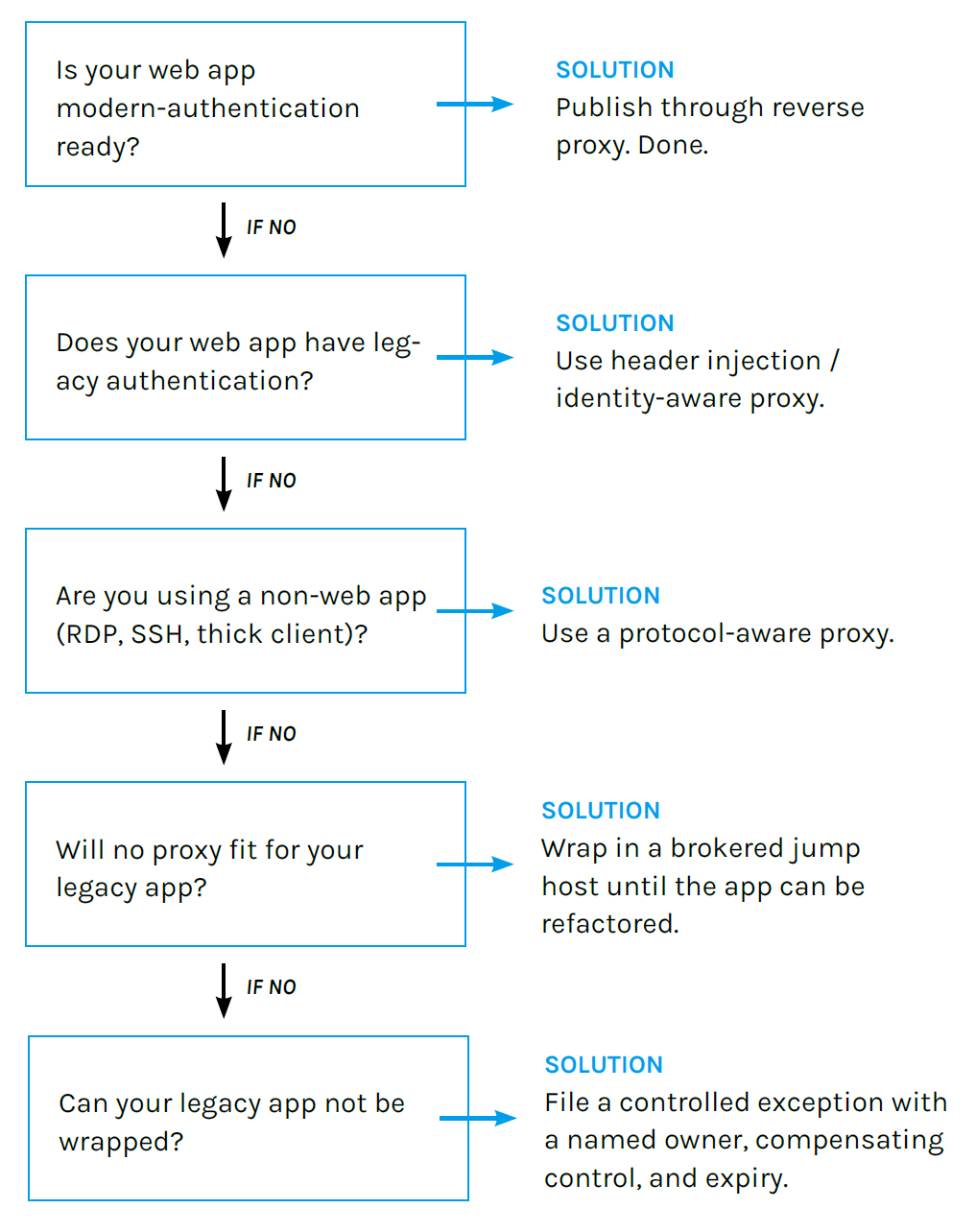
Legacy Application Decision Tree
Most application portfolios contain legacy systems that do not speak modern authentication. The decision tree below walks through the choices for handling them in priority order. Modern, auth-ready applications publish through a reverse proxy and you are done. Everything else needs a deliberate compensating pattern. Resist the temptation to skip a step and grant network-level access just for one legacy application because ‘just one’ is how permanent exceptions begin.
Policy Structure: A Template That Scales
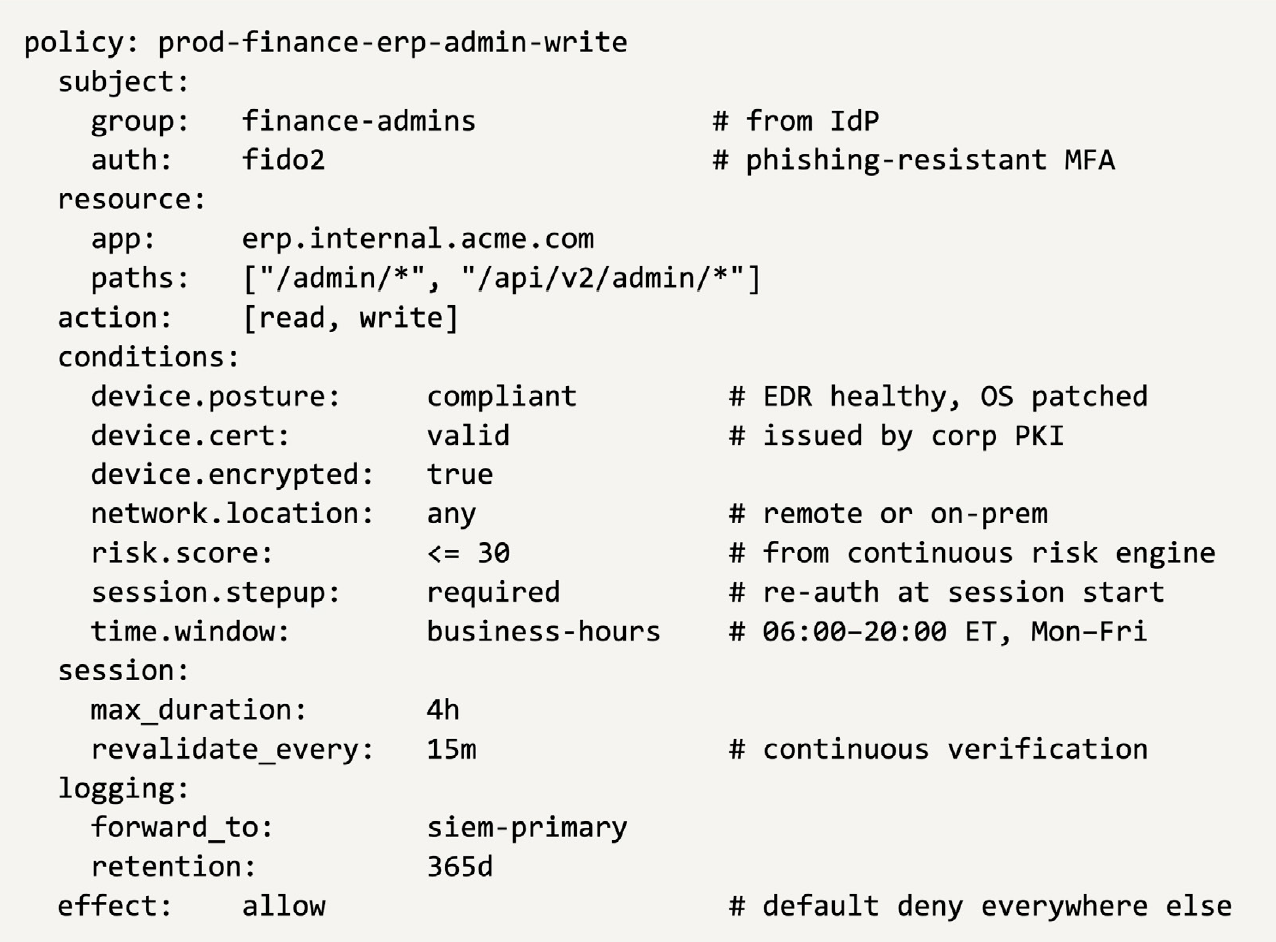
Every UZTNA policy must specify: subject + action + resource + conditions.
Every UZTNA policy specifies four elements: subject, action, resource, and conditions.
- The subject is the user, group, service account, or workload identity with an applicable policy.
- The action is the verb being authorized — read, write, administer, connect, or an applicationspecific operation.
- The resource is the specific application, URL path, or API endpoint the action targets.
- And the conditions are the runtime context that must hold for the policy to grant: device posture, network location, time of day, risk score, step-up state.
A policy missing any of those four elements is implicitly relying on an assumption that will eventually be wrong.
Policy Authoring Rules
- Start with deny-all and add explicit allows: The reverse – allow-all with explicit denies – has produced every lateral-movement breach in recent memory.
- Prefer ABAC layered on top of RBAC: Use attribute-based access control layered on top of role-based access control. Use roles for the baseline and attributes for the context.
- Name policies consistently: Use a pattern such as <env>-<app>-<role>-<action> so that the name carries its own audit trail.
- Test in shadow mode for seven days: Test every new policy in shadow mode for seven days before enforcing it.
- Treat every exception as time-limited and scoped: Every exception must have auto-expiry and required renewal. Permanent exceptions are how “universal” becomes “partial” over time.
- Manage policy as code: Version-control it, and review changes through the same process you use for infrastructure and require the same approval rigor.
Sample Policy: Finance App, On-Prem, Privileged
Don’t Do This
- Grant network-level access ‘just for one legacy app’.
- Write policies that allow by default and deny by exception.
- Let exceptions live without a named owner and an expiry date.
Chapter 7 – Monitor, Measure, Mature
UZTNA produces more access telemetry than most security teams know what to do with. The day-two work of any UZTNA program is converting that telemetry into three things:
- Detections that the SOC can act on.
- Evidence that auditors can consume.
- Signals that drive measurable improvement in the access posture.
An organization that ships UZTNA without that pipeline has bought a very expensive log generator.
SIEM and SOAR Integration
Integration with SIEM and SOAR is what turns telemetry into operations. Forward every event above to the SIEM with a consistent schema because schema drift is the silent killer of correlation rules. Author correlation rules for the access patterns that actually indicate compromise:
- Impossible travel between authentication events.
- Mass denial bursts on a single account.
- Posture downgrades during an active session.
Codify SOAR playbooks for the three highest-leverage responses — session revocation, device quarantine, and IdP account hold. Why? Because those are the actions that contain a breach in the first hour. Then, measure mean-time-to-revoke-a-session as a board-reportable KPI
with a target of under sixty seconds. That metric is the single most honest measure of how real your UZTNA program is operationally.
Quick-Mapping: Compliance Evidence
UZTNA produces evidence that maps cleanly to four common control regimes.
- HIPAA access logs satisfy the Security Rule’s access-control and audit-trail requirements.
- CMMC 2.0 directly benefits from the Access Control (AC) domain coverage that UZTNA delivers.
- NIST SP 800-207 treats UZTNA as a direct implementation pattern of the Zero Trust Architecture which simplifies the conformance story for federal-facing programs.
- SOC 2 Type II auditors will accept UZTNA telemetry as direct evidence for the CC6 logical access controls.
In each case, the work is configuring the SIEM forwarding and the retention policy correctly the first time, so the evidence collects itself.
Required Telemetry Feeds
- Authentication events with full context: Every successful and failed authentication with user, device, location, and risk score.
- Access grant and deny events per application and per user: So that the SIEM can answer ‘who reached what, when, and on whose authority’ as a single query.
- Policy change audit log: The only durable record of who softened which control.
- Device posture change events: A posture downgrade mid-session is one of the highest-fidelity attack signals available.
- Continuous-risk engine’s alert and step-up trigger stream: Tells you when the system caught something the static policy missed.
Program KPIs the Board Should See
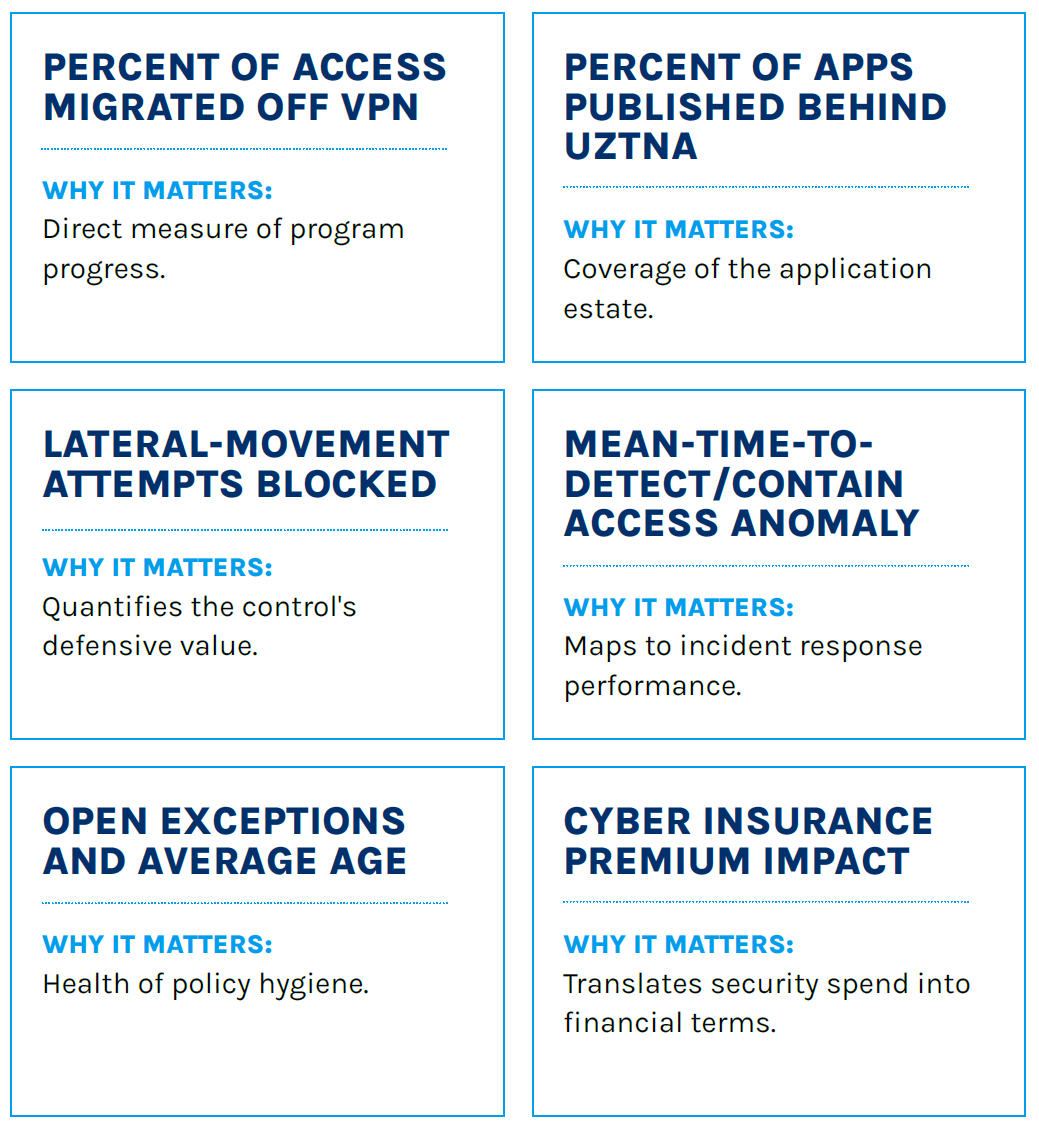
Resist the urge to report uptime or alert volume — both are easy to game and neither tells the board whether the program is working.
Measure mean-time-to-revoke-a-session as a board-reportable KPI with a target of under sixty seconds. That metric is the single most honest measure of how real your UZTNA program is operationally.
UZTNA is a program, not a project.
The organizations that treat it as a one-time deployment will be the ones calling after the breach. The ones who treat it as an operating discipline will never need to.
Don’t Do This
- Ship UZTNA telemetry to the SIEM without correlation rules. Logs alone do not detect.
- Report only on uptime. The board needs blast-radius and migration KPIs.
- Treat the deployment as ‘done’ and move the team off to the next project.
First 90 Days
The UZTNA Plan-on-a-Page
Print it. Tape it to the wall. If you finish each column’s exit gate, you finish the program. If you skip one, you will have to rebuild it inside of a year.
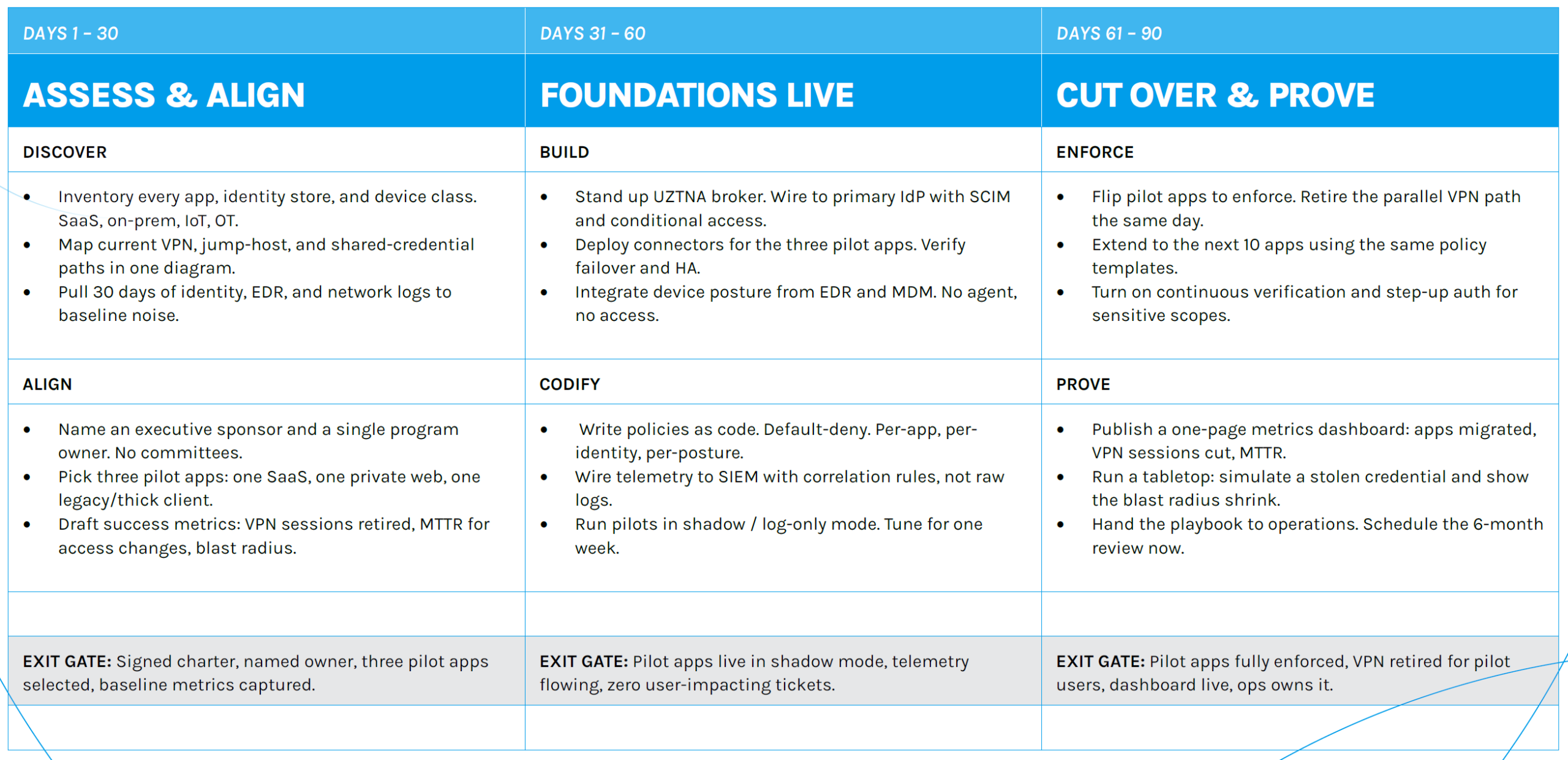
If a column slips, do not move on. Slipping a gate is cheaper than rebuilding the next phase on a broken foundation.
Vendor Evaluation Grid
Use this grid to score UZTNA vendors apples-to-apples. Weight each category 1–3 based on your environment, then score each vendor 0–5 per row. Multiply weight × score and total the column.
| Category | What to demand in the demo | Wt. | V1 | V2 |
|---|---|---|---|---|
| Identity integration | Native connectors for Okta, Entra ID, Ping. SCIM provisioning. Workload identity (SPIFFE). | |||
| Device posture | Live posture from Intune, Jamf, Workspace ONE, and your EDR. In-session re-evaluation. | |||
| App connector coverage | Web, RDP, SSH, thick-client, database. HA pairs. On-prem and cloud connectors. | |||
| Policy engine | ABAC + RBAC. Shadow mode. Policy-as-code with API or Terraform support. | |||
| Continuous risk | Real-time risk scoring with step-up and revoke actions. Configurable thresholds. | |||
| IoT / OT support | Cert-based device identity. Passive discovery. Micro-segmentation that does not require an agent. | |||
| Telemetry / SIEM | Structured logs, native Splunk and Sentinel integrations, sub-minute event latency. | |||
| Automation / APIs | Documented REST API. Webhooks. No “call support to change a policy” patterns. | |||
| Performance | Global PoP coverage, published p95 latency, transparent SLAs. | |||
| Pricing model | Per-user, per-app, or per-bandwidth. Predictable at 3x current scale. | |||
| Roadmap & support | Named CSM. Quarterly roadmap reviews. Reference customers in your industry. | |||
| Totals | — |
Red flags you cannot ignore:
- ‘Universal’ in marketing but no on-prem connector or no IoT story.
- Policy changes require a support ticket or vendor professional services.
- No shadow / log-only mode for new policies.
- Cannot produce a sample SIEM event schema on request.
- Reference customers are all in unrelated industries or sizes.
Regulatory Mapping
Use this table to point auditors at the UZTNA capability that satisfies each control area.
| Framework | Relevant Control Area | UZTNA Capability That Maps |
|---|---|---|
| HIPAA Security Rule | Access control, audit controls. | Identity-aware access; centralized access logs. |
| CMMC 2.0 | Access Control (AC) domain. | Least-privilege policy; continuous verification; session control. |
| NIST SP 800-207 | Zero Trust tenets. | UZTNA is a direct implementation pattern. |
| SOC 2 Type II | Logical access (CC6 series). | Policy evidence; access reviews; revocation telemetry. |
| EO 14028 | Federal Zero Trust mandate. | Universal enforcement model satisfies access-pillar requirements. |