For years, security architects have been told that Zero Trust starts with replacing the VPN. In reality, that’s where many programs stop. The result is an environment where remote users receive modern access controls while on-prem users, legacy applications, OT systems, service accounts, and unmanaged devices continue to operate under completely different trust assumptions.
Universal Zero Trust Network Access (UZTNA) closes that gap. It extends Zero Trust principles across every user, every device, every workload, every application, and every access path, regardless of location or ownership. More importantly, it does so using consistent policy enforcement rather than a collection of disconnected security controls.
For architects tasked with designing resilient enterprise security programs, UZTNA represents a fundamental shift in thinking. Here are seven things every architect should understand before designing their next Zero Trust initiative.
1. “Universal” Is Not a Marketing Term. It’s the Acceptance Criteria.
The biggest misconception in the market is that Universal ZTNA is simply a bigger version of ZTNA.
It isn’t.
Traditional ZTNA primarily solved remote access. Universal ZTNA expands the same enforcement model to all users, all devices, all workloads, and all applications, whether they reside in the cloud, a private data center, a manufacturing plant, or a hospital network.
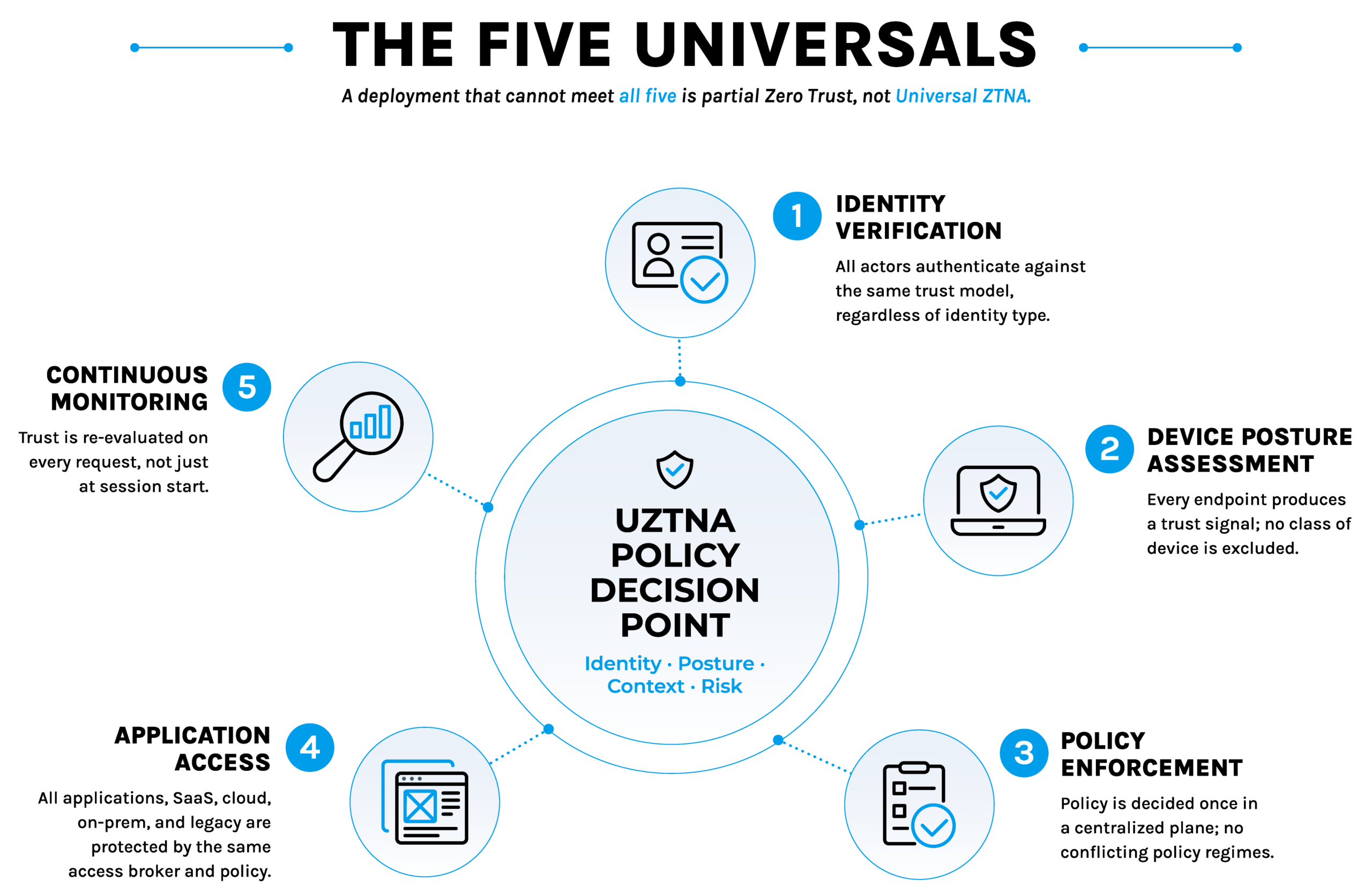
The Universal ZTNA practitioners guide defines five non-negotiable outcomes that determine whether a deployment is truly universal:
- Universal identity verification
- Universal device posture assessment
- Universal policy enforcement
- Universal application access
- Universal continuous monitoring
If any category is excluded, the architecture may still be Zero Trust-inspired, but it is not Universal ZTNA. It’s what we call “The Five Universals” in the guide.
2. Zero Trust Architecture Matters More Than Vendor Selection
Many Zero Trust projects begin with product evaluations.
Architects should start somewhere else entirely.
According to the Practictioner’s Guide implementation roadmap, successful programs begin with architecture and readiness, not procurement. Organizations that purchase technology before understanding identity maturity, application inventory, device visibility, and policy ownership often discover major gaps after deployment has already begun.
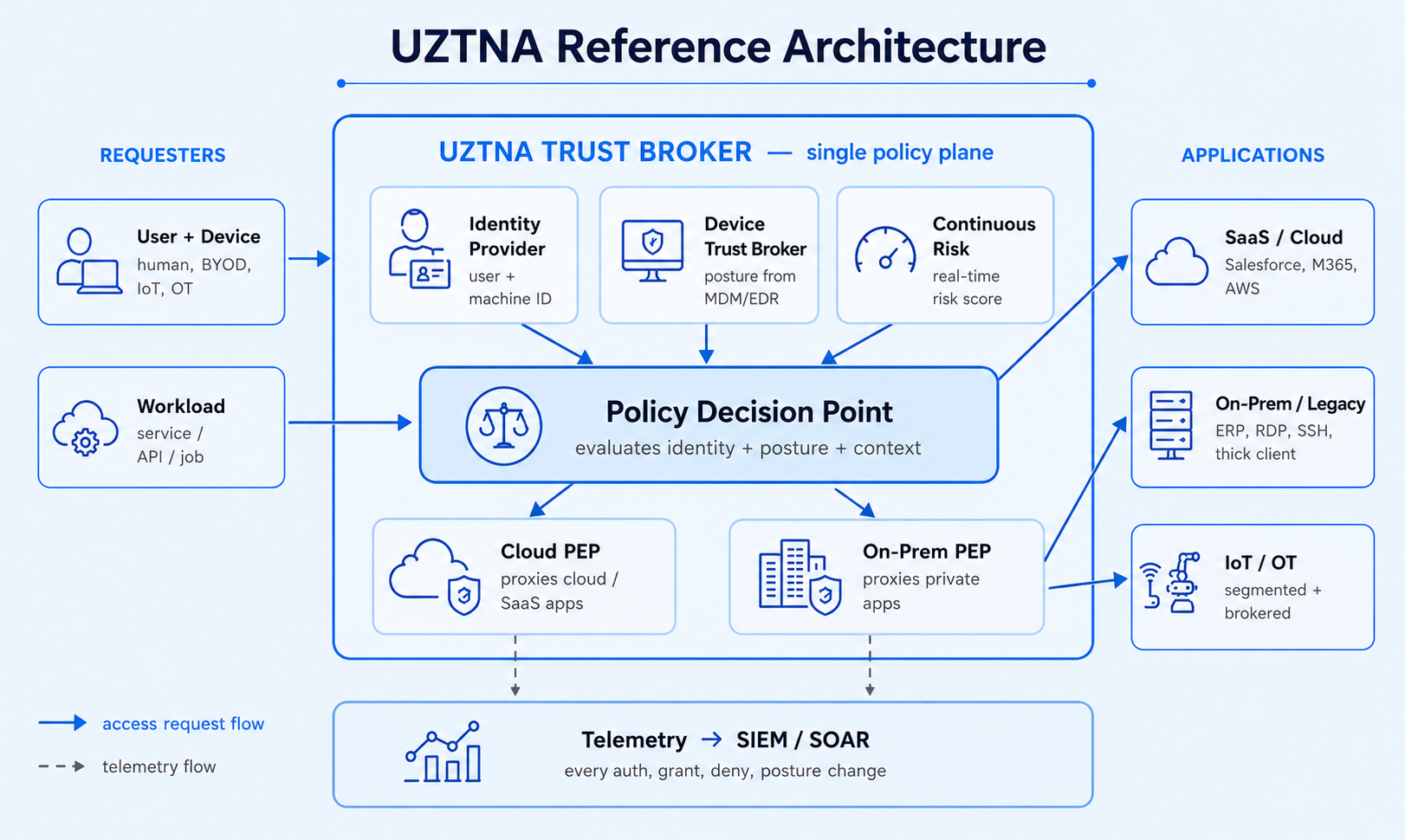
A Universal ZTNA architecture consistently includes the same logical components regardless of vendor:
- Identity provider
- Device trust broker
- Policy decision point
- Policy enforcement points
- Application connectors
- Continuous risk engine
- Telemetry pipeline
Different products may implement these functions differently, but architects should design around required capabilities rather than product categories or vendors.
The most successful deployments treat technology as an implementation choice, not the architecture itself.
3. If You Haven’t Inventoried It, You Can’t Protect It
Every architect loves discussing policy engines and identity workflows.
Few enjoy inventory projects.
Unfortunately, inventory is where successful UZTNA deployments begin.
The guide repeatedly emphasizes that application, identity, device, and network inventories are foundational requirements. Organizations cannot consistently enforce least privilege against assets they don’t know exist.
Architects should ensure visibility across:
- Identity stores and directories
- Service accounts
- Contractor accounts
- Managed devices
- Unmanaged devices
- IoT assets
- OT systems
- Cloud applications
- On-prem applications
- Network segments
One of the most common causes of implementation failure is discovering undocumented applications or unmanaged device populations halfway through a rollout. By that stage, exceptions begin accumulating and the “universal” model starts breaking down.
In practice, inventory is not administrative work.
It is architectural work.
4. Identity Alone Is Not Enough
Identity has become the centerpiece of most Zero Trust discussions.
That’s necessary, but insufficient.
Effective Universal ZTNA decisions combine identity, device posture, application context, and runtime risk signals into a single access decision. A valid user credential does not automatically imply that a device should be trusted or that every request should be approved.
Architects must plan for a broad trust spectrum.
A managed corporate laptop may provide rich posture telemetry through EDR, certificates, and endpoint management systems. An unmanaged contractor device may require agentless access and limited privileges. IoT devices often require network-level controls instead of endpoint controls. OT assets frequently require compensating controls because agents and traditional authentication are not available.
The key architectural lesson is simple:
Trust decisions should be based on evidence, not assumptions.
Every device class must contribute a trust signal, even when that signal is different from a traditional endpoint.
5. Legacy Applications Will Define Your Success
Most Zero Trust marketing materials focus on SaaS applications. Most enterprise environments do not.
Architects know that business-critical systems often include decades-old applications that were never designed for modern authentication or policy enforcement.
Ignoring them creates permanent exceptions.
This is where many Zero Trust initiatives lose credibility.
If the HR portal is protected by modern Zero Trust controls while the manufacturing system or financial application still relies on broad network access, the organization has simply shifted risk rather than reducing it.
Universal enforcement requires architects to confront legacy application realities head-on.
6. OT and IoT Change the Rules
Architects who have spent most of their careers in enterprise IT often discover that OT environments play by different rules.
Many OT systems cannot:
- Run agents
- Support modern authentication
- Accept patches on demand
- Be taken offline for maintenance
Yet they still require protection.
This reality is one of the strongest arguments for Universal ZTNA.
Rather than forcing IT-centric controls onto OT systems, architects can apply alternative trust signals such as:
- Network location
- Certificate identity
- Passive discovery
- Protocol fingerprints
- Segmentation controls
- Brokered access models
For OT and many IoT environments, network-level micro-segmentation becomes the primary enforcement mechanism. Identity still matters, but containment becomes equally important.
Architects must design for operational realities, not idealized endpoint assumptions.
The organizations that succeed are the ones willing to adapt Zero Trust principles to constrained environments instead of exempting them entirely.
Go deeper: Watch Forescout engineer Nick Cincotta break down Universal ZTNA to shows what’s achievable.
7. UZTNA Is a Program, Not a Deployment
Perhaps the most important lesson for architects is that Universal ZTNA does not have a finish line.
The practitioner’s guide describes a phased journey that progresses from readiness assessment through identity consolidation, application migration, on-prem parity, IoT/OT coverage, and ongoing optimization. Each phase builds on the previous one and includes measurable exit criteria.
Even after implementation, organizations continue refining policies, retiring unused rules, validating telemetry, reducing false positives, and advancing maturity over time.
The most meaningful metrics are not technology metrics. They are risk and operational metrics, including:
- Percentage of access migrated off VPN
- Percentage of applications protected by UZTNA
- Lateral movement attempts blocked
- Mean time to detect and contain anomalies
- Exception inventory and age
- Business impact measurements
Architects who view UZTNA as a deployment project will eventually hit limits.
Architects who treat UZTNA as an operating discipline create a foundation that evolves alongside the business and continues reducing risk year after year.
Final Thoughts
Universal ZTNA is not about adding another security tool to an already crowded architecture. It is about eliminating inconsistency.
The core challenge for architects is no longer securing remote users. It is applying the same trust model across cloud workloads, private applications, contractors, service accounts, IoT devices, OT systems, and everything in between.
When architects focus on universal enforcement, continuous verification, inventory accuracy, and exception reduction, Zero Trust stops being a collection of technologies and becomes an operational reality.
And that’s ultimately the difference between a Zero Trust initiative and a Universal Zero Trust program.
If you’re serious about Zero Trust, see how to apply it universally. Our step-by-step guide is a detailed, non-nonsense resource built for security pros who do the work by security pros who have done the work — (DrZeroTrust himself, Dr. Chase Cunningham).
There’s no registration form or data that you have to give us.