Can Universal Zero Trust Network Access (UZTNA) replace Network Access Control (NAC)?
Short answer: In many environments, yes. But that’s not the right question. Here’s why: NAC was built for a network-centric world that answered one practical question: should this device be allowed onto the network? That question still matters, but it’s no longer sufficient.
Today’s organizations are distributed across cloud applications, SaaS platforms, data centers, branch offices, remote users, third-party networks, unmanaged devices, OT systems, and IoT devices. The network is no longer the single place where work happens. It’s one of many places where access decisions are being made and enforced.
The real question is not whether UZTNA can replace NAC. It’s whether a point-in-time network admission model can keep up with how access actually works today.
Spoiler alert: it can’t.
UZTNA is the evolution of NAC.
It moves access control from a connection event to a continuous trust decision. It does not ask whether something should connect. It asks whether a user, device, workload, application, or system should have concurrent access based on current context, current risk, and current policy.
The Problem NAC Was Never Designed to Solve
NAC still has a place when: most users work in offices, apps live in corporate data centers, and [most] devices are managed endpoints. In this scenario, network admission is a reasonable control point. However, when your environment is hybrid and users and apps are no longer in one place, then the network-centric access model breaks down.
This is why the old question ‘should this device be allowed onto the network?’ falls short. It doesn’t answer critical questions, such as:
- Should this identity access this application right now?
- Should this unmanaged device communicate with that system?
- Should this workload reach that service?
- Should this contractor have access from this location under these conditions?
- Should this OT asset continue communicating after its behavior changes?
- Should this AI agent or workflow be allowed to touch sensitive systems at all?
These are not network admission questions. They are continuous access questions.
What Changes with Universal ZTNA?
Two things change, and the second is the one most organizations have missed to date.
1. The shift from NAC
UZTNA moves access from a one-time connection decision to a continuously evaluated condition. NAC asks whether something can or should get on the network. UZTNA asks whether something should still reach what it is trying to reach, continuously evaluated against live identity, posture, and risk telemetry.
| NAC | UZTNA |
|---|---|
| Point-in-time admission decision | Continuous access decision |
| Network-centric | Identity and context-centric |
| Location-sensitive | Location-independent |
| Connection-focused | Resource-focused |
| Admit or deny | Continuously verify, adapt, and revoke |
| Network access | Access across users, devices, workloads, applications, and environments |
2. The shift from traditional ZTNA
Traditional ZTNA did one job: replace the VPN for remote users. That helped, but it only ever covered people working off-network. Everything else, on-prem apps, IoT, and OT, stayed outside the model. ‘Universal’ is what closes that gap. It means the same access rules apply to every user, device, and workload, wherever they are, not just remote users.
Universal ZTNA is what enables the evolution beyond NAC while building on the principle of covering every device.
Go deeper: Watch our video “How to Design a Practical UZTNA Policy Framework”:
NAC Is a Capability, Not a Platform
NAC is not dead. But standalone NAC as the center of access control is the wrong model now because the access problem has become bigger than the network. While the network remains the immutable source of truth, it is not the primary control plane.
Today, the access control plane must span campus, branch, remote assets, cloud, data center, IoT, OT, third parties, and non-human identities. No standalone admission control system was designed to be the organizing layer for all of that. As a result, NAC’s role shifts. It becomes one enforcement capability inside a broader Universal ZTNA architecture.
It means organizations do not – and should not – need to throw away NAC investments. In a UZTNA model, asset intelligence, risk context, policy governance, segmentation, and enforcement have to operate together.
The destination is not ‘better NAC’ but a practical architecture that can continuously decide, enforce, and adjust access across the real enterprise. Kinda sounds like policy decision point, doesn’t it?
How to Transition from NAC to UZTNA
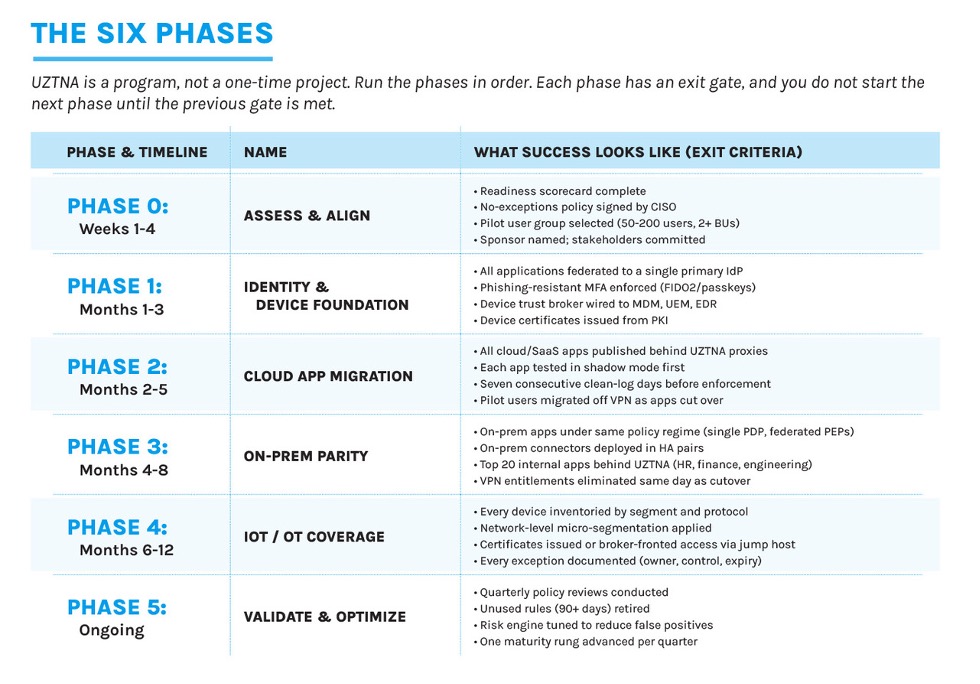
Here are the six steps to transition from NAC to Universal ZTNA. It is a phased transition grounded in architecture, operational reality, and measurable progress.
The Final Word: the Evolution of NAC
So, can UZTNA replace NAC? In many environments, it can replace large portions of what NAC historically used to do. But replacement was never the real story. This is evolution, not a teardown.
UZTNA evolves and enhances what made NAC the center of access control in the first place. That was a simpler time, but alas, that world is gone. Cloud applications, distributed workloads, unmanaged devices, IoT, OT, third-party access, and AI-agents all need their own control plane and enforcement point, evaluated continuously with current context, and enforceable policy across the environment.
That’s the evolution. NAC asked whether something could get on the network. UZTNA asks whether it should still be there, and whether it should reach what it’s trying to reach. Same instinct. Bigger scope. Continuous enforcement. It’s the more realistic architecture for the environment we actually have to secure now and for what comes next.