Something fundamental has shifted in cybersecurity. The platforms being targeted, the tactics being used, the software being exploited are largely familiar. What has changed is the speed. Frontier AI models are collapsing the timeline between a vulnerability existing, being discovered, and being weaponized. For defenders, that compression changes everything.
This is the topic recently discussed in detail in a widely attended webinar (available on-demand) by Rik Ferguson, VP of Security Intelligence, and Shawn Taylor, Field Technology Officer at Forescout. The title of the webinar is “The Zero-Day Clock Just Broke: How to Prepare Your Cybersecurity for the Frontier AI Era”.
What Frontier AI Actually Does to the Threat Landscape
Claude Mythos, Anthropic’s most advanced model, has demonstrated a remarkable ability to uncover novel vulnerabilities, develop working exploits, and chain vulnerabilities together in ways that were previously beyond automated tools.
Last year, Vedere Labs research showed that it was still very difficult to make this kind of automation into real working exploits: 55% of AI models failed basic vulnerability research and 93% failed exploit development tasks.
But so much has changed in a short amount of time. In 2026, Vedere Labs again studied these AI models and they all completed vulnerability research tasks — and half can generate working exploits autonomously.
Critically, Anthropic itself considered its capabilities serious enough that it has restricted access through a controlled program (Project Glasswing) rather than release it publicly. OpenAI has taken a similar approach with its own frontier models.
But here’s the thing that often gets lost in the headlines: the significance isn’t any single model. It’s what these models represent as a class. The vulnerability pipeline has never been the problem for defenders. Security teams are already drowning in disclosures, advisories, and patch backlogs they can’t fully operationalize. What Mythos and its successors do is accelerate that reality further and faster than any organization’s current response capacity is built to handle.
A real-world example puts this in sharp contrast: using Mythos, researchers discovered a critical vulnerability in the WolfSSL cryptographic library (rated 9.3 on the CVSS scale, 10 by Red Hat) affecting an estimated 5 billion devices across routers, industrial control systems, smart grids, automotive systems, and more.
That finding came from a single prompt. The scale and speed of discovery is qualitatively different from what came before.
The Mindset Shift: From ‘Assume Breach to ‘Assume Autonomy’
For more than a decade, the dominant security philosophy has been ‘assume breach’: architect your defenses on the premise that attackers will get in, so plan accordingly. That remains valid. But it’s no longer sufficient.
The next evolution is to assume autonomy. This is a new framework that has been formalized by Ferguson in a newly published paper (which requires no form to fill out to download).
Here’s the context directly from the Author’s Note that he opens the paper with:
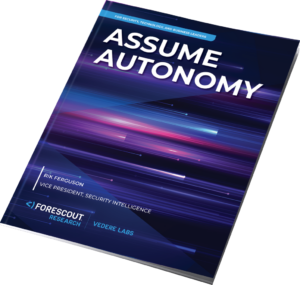 “This paper formalizes Assume Autonomy, an argument I have developed publicly since 2017: that AI would enable autonomous attack machinery, force defenders to account for non-human adversarial behavior, and require authenticated, authorized, observed, and reversible autonomous defensive action. Trusted Autonomy is used here in a cyber-defense context, not as a claim over the broader research term. In this paper, it means autonomous defensive action operating within human-governed boundaries, under adversarial conditions, without creating more risk than it removes.”
That means operating on the assumption that your adversaries are using autonomous, AI-driven tools and that your defenses will need to match that speed. An autonomous attacker thinks and acts in ways humans do not. And this is at speeds humans cannot match manually.
The answer? Well, first, don’t panic. Right now, it’s about building toward what can be called trusted autonomy on the defensive side. Trusted autonomy is a specific state built on four conditions, all of which must be in place:
1. Context
Your systems need to understand not just that a vulnerability exists, but where the affected asset sits, what it connects to, what the business impact of touching it would be, and what the likely outcome of any action is.
2. Constraint
Autonomous actions should operate within defined boundaries: by asset type, environment, and risk tier. Broad, unconstrained actions are where trust breaks down.
3. Reversibility
If an autonomous action takes place, can you undo it at the same speed it was implemented? Designing for reversibility from the outset is what builds the confidence needed to act decisively.
4. Transparency
People need to understand why a recommendation is being made or an action taken. When reasoning is visible — even if machine-generated — it becomes possible to validate it, learn from it, and correct it when it’s wrong.
What to Actually Do Right Now
The practical starting point is deceptively simple: know what’s on your network beyond the IT you already have eyes on. Know every device. Operational technology designed to run for decades. IoT devices that come and go. IP cameras, medical systems, building management infrastructure, industrial controls. Attackers are already exploiting exposed edge devices as entry points, and AI-powered tools will be scanning every available codebase for vulnerabilities in all of it.
For each of those assets, you need to know its firmware and software patch level, what it connects to, and what risk it carries — because two devices with the same vulnerability can have very different risk profiles depending on their mission criticality and exposure.
From that foundation, the priority becomes continuous assessment and risk-based prioritization. The most important question in security right now is not “what are all the vulnerabilities?” — it’s “what should I be doing first?” With an avalanche of disclosures coming, the organizations that fare best will be the ones who can answer that question quickly, repeatedly, and automatically.
The Clock Is Running
Frontier AI models are currently restricted to vetted organizations. That window will not stay open indefinitely. Security teams that use this period to build full asset visibility, implement meaningful network segmentation, and develop the automation needed to respond at machine speed will be in a fundamentally different position from those that wait. The defenders who win in the AI era will already have these foundations in place and won’t need to scramble to build them when the threat is already at scale.
The zero-day clock just broke. The time to prepare is now.